AI, Abundance and the End of Jobs as Our Operating System
Everywhere you look, the same question shows up:
“How many jobs will we lose to AI?”
TV talk shows debate numbers. Consultants publish charts. Politicians promise “retraining”.
But if you’ve been building software and automation systems for a few decades, you start to feel that the whole conversation is… too small.
We’re not just talking about jobs. We’re talking about the end of the labour-based economy as our default operating system.
That’s the core message of Emad Mostaque’s book The Last Economy and David Shapiro’s work on Post-Labor Economics – and it’s exactly where my own thinking has landed after 35+ years in ICT.
In this article, I want to connect three things:
- What we’re seeing in practice with AI and automation
- The blueprint sketched in The Last Economy
- The implications of Shapiro’s Post-Labor Economics
And then ask the only question that really matters:
How do we build an economy for a world where intelligence and labour are no longer scarce?
From “AI bubble” to economic phase transition
You often hear: “AI is just another bubble – like dotcom or crypto.”
They might be right about financial bubbles. AI companies and chip manufacturers can absolutely be overvalued. That happened in the dotcom era too.
But as we learned then: 🧨 a stock market bubble says almost nothing about the underlying technology.
Under the froth, the technology keeps compounding.
In my lifetime in ICT I’ve watched wave after wave:
- relational databases
- component-based development
- web apps and browsers as the UI
- workflow engines, business rules engines
- NoSQL, document and graph databases
- event-driven architectures
From the outside, each of these looked like a “hype cycle”. From the inside, it was evolution: new abstraction layers built on top of old, allowing fewer people to create more leverage.
AI – especially machine learning and large language models – is the next layer in that stack. Not magic. Not a toy. Just an extremely powerful new way to turn data + compute into decisions, designs and actions.
So no, AI isn’t “just a bubble”. It’s the technology that finally makes a much older assumption obsolete:
that human intelligence and human labour are the bottleneck in the economy.
The Last Economy: when intelligence stops being scarce
In The Last Economy, Emad Mostaque argues that we’re not in a “recession” or a normal cycle at all – we’re in a phase transition.
For roughly 300,000 years, intelligence was scarce:
- Humans monopolised thinking.
- Education turned into higher earnings.
- Cognitive labour – engineers, lawyers, bankers, analysts – commanded a premium.
AI breaks that.
Most of the tasks we called “knowledge work” can now be done by machines that don’t sleep, don’t unionise, and improve with every token of data they ingest.
Mostaque calls this the Intelligence Inversion: intelligent systems become cheap and abundant, while meaningful human attention and agency become the constrained resource.
That flips the logic of our current system:
- Our economics still assume scarcity – of labour, of capital, of expertise
- Our dashboards still optimise for GDP and profit, not for resilience, dignity, or human flourishing
- Our institutions still tie human worth to economic utility
The book’s core proposal, in my reading:
We need a new economic OS that treats abundance as a feature, not a bug – and that deliberately protects human agency at scale.
That means:
- decoupling income from wage labour
- designing new metrics for progress
- and rebuilding institutions so they can govern an economy where machines do most of the productive work.
David Shapiro: Post-Labor Economics in practice
Where The Last Economy offers a systems-level blueprint, David Shapiro zooms in on a very concrete question:
“How does an economy actually function when AGI and robots can do almost all the jobs?”
In his talks and lecture series on Post-Labor Economics, he explores what happens when:
- AI agents run most operations “better, faster, cheaper, safer” than humans
- human labour is no longer the primary input to production
- wages can’t be the main way people access goods and services anymore
Some of the themes he keeps returning to:
- Who owns the machines? If capital owns all the productive AI/robots, then without strong redistribution mechanisms, inequality explodes.
- How do we distribute purchasing power? Universal basic income, social dividends, or new forms of public/collective ownership – these aren’t utopian anymore, they’re plumbing questions.
- What do humans actually do? In a post-labor world, work shifts from survival to contribution, creativity, care, governance and meaning-making.
Shapiro calls this post-labor economics not because there will be no labour, but because labour is no longer the core organising variable of the system.
Taken together, Mostaque and Shapiro are saying:
If we treat AI as just “efficiency tech” inside a labour-based system, we break society. If we redesign the system around abundance and human agency, we get a chance at humane prosperity.
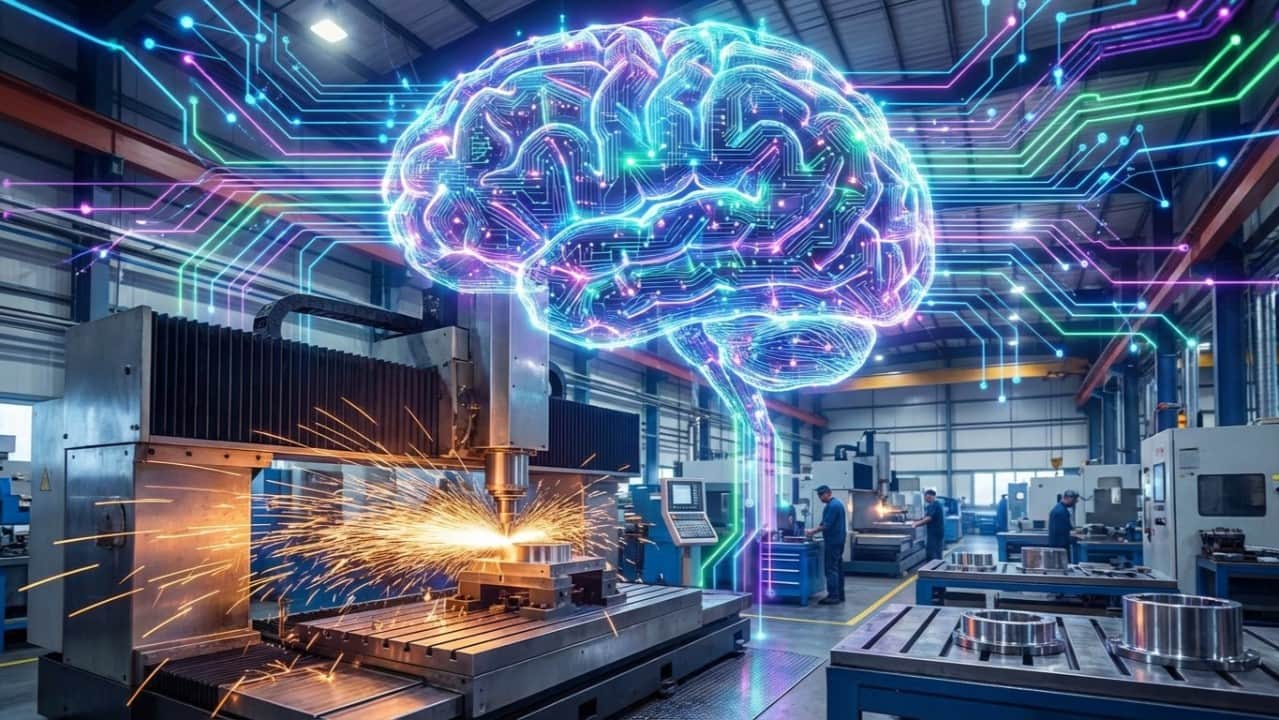
What this looks like from the factory floor All of that can sound abstract. So let’s bring it down to earth.
In my livestream I argued that:
- AI + robotisation will create an intelligence and experience explosion
- If you feed these systems with enough data and embodiment, easily 50–60% of today’s work can be automated
- A huge chunk of existing jobs don’t have real, long-term “right to exist” once you remove artificial friction
You see early signs of this everywhere in IT and industry:
- User interfaces, CRUD layers and simple data workflows can already be generated dynamically by AI
- Whole categories of systems – ERP, MES, PLM, CRM – are, at their core, data storage + validation + UI. Much of that can be re-architected with AI-native building blocks.
- Old optimisation algorithms can be wrapped, extended or replaced with ML systems that learn from edge cases and messy, real-world input.
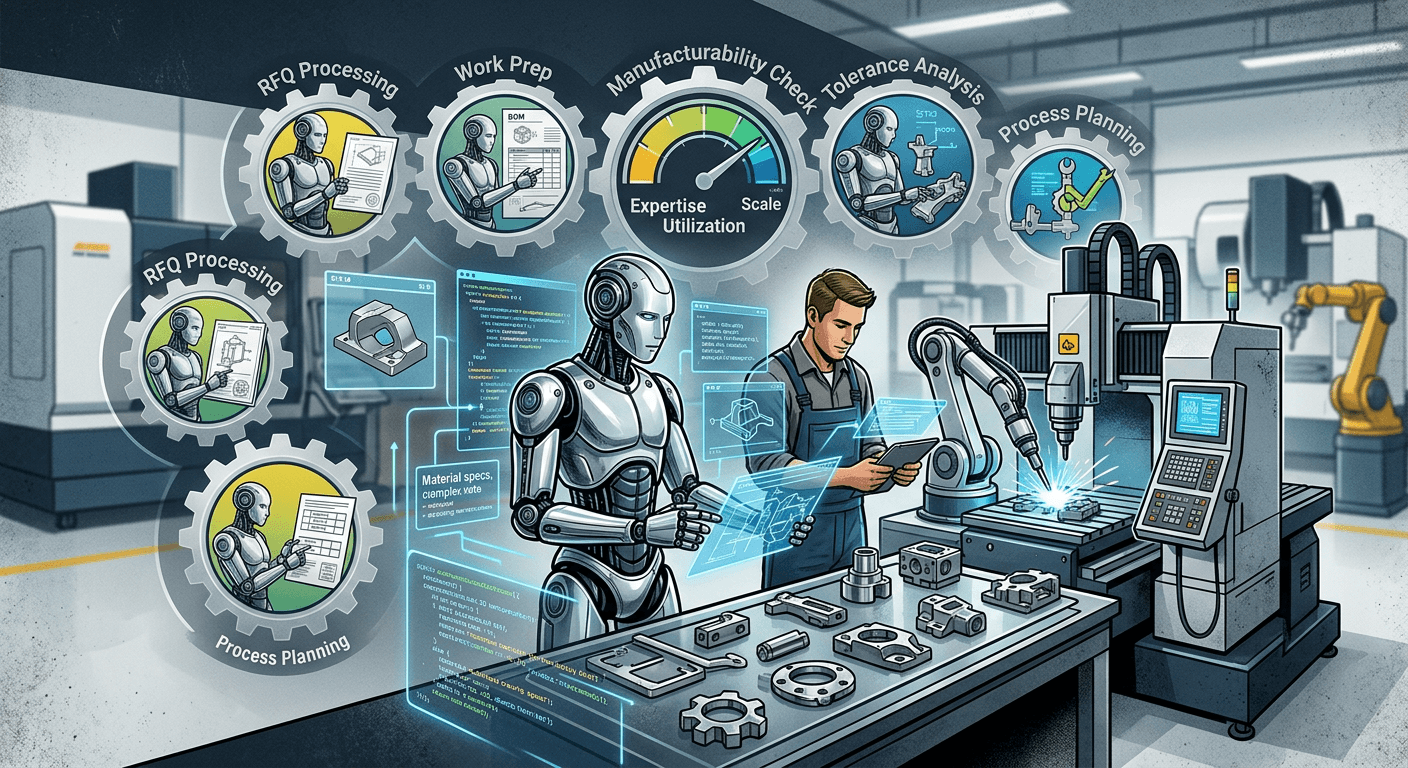
In the manufacturing and metal industry, that means:
- quotations that used to require humans juggling 2D drawings, 3D CAD files, PDFs and emails can be largely automated
- NP-hard scheduling and nesting problems can be attacked with a combination of classic operations research and machine learning
- a small number of humans can orchestrate a much larger volume and variety of work
In that world, human operators become designers of systems and stewards of exceptions, not the main source of productive effort.
That is exactly what a post-labor economy looks like at the micro level.
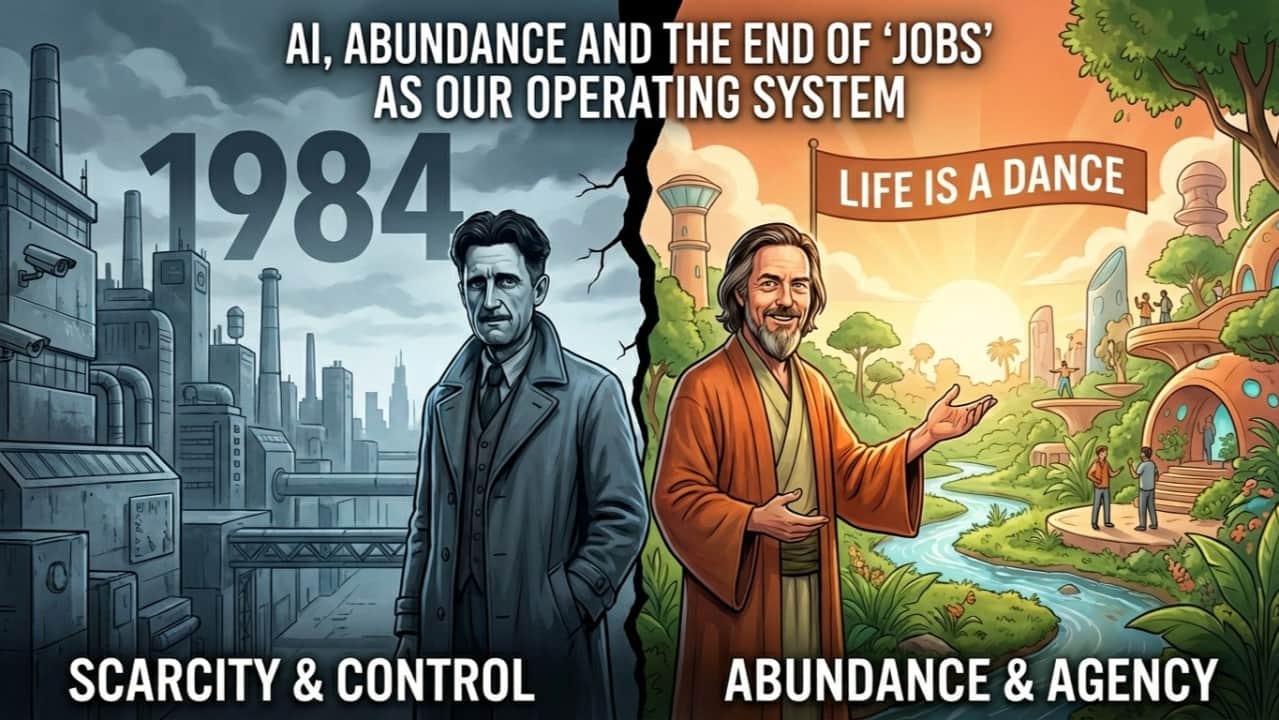
From scarcity logic to abundance logic
Put all of this together and you get a simple contrast.
Scarcity-based economy (the one we still run):
- assumes labour is scarce and must be allocated through markets
- ties income and social status to jobs
- optimises companies for short-term profit and efficiency
- measures success with GDP and quarterly earnings
Abundance-based, post-labor economy (the one we need to design):
- assumes intelligence and productive capacity are abundant
- treats human agency, attention, trust and meaning as the scarce resources
- designs institutions to distribute access to the outputs of AI-driven production
- measures success with richer dashboards: material well-being, intelligence, networks, diversity, resilience
That’s the bridge between my “AI is not a bubble” rant, The Last Economy, and Shapiro’s work:
We’re not just upgrading tools. We’re rewriting the economic rulebook.
So what do we do now?
If you’re a business leader, policymaker or technologist, I don’t think the responsible move is to “wait and see”.
Here are a few practical steps that align with a Last-Economy / Post-Labor view:
- Map your automation frontier honestly List the tasks in your organisation that could be handled by AI + robots in the next 3–5 years, not just the ones you’re comfortable with.
- Redefine roles around design and governance Start shifting key people from “doing the work” to designing, supervising and improving systems that do the work.
- Experiment with decoupling income from hours Profit-sharing, project-based rewards, internal “dividends” – small experiments inside firms can teach us about post-labor income models before we try them at national scale.
- Update your mental metrics Don’t just track output and cost. Track resilience, knowledge capture, human growth, and the quality of decisions. That’s much closer to the “intelligent economics” Mostaque argues for.
- Join the design conversation, not just the panic Read The Last Economy. Watch Shapiro’s Post-Labor Economics lectures. Then ask: “Given this trajectory, what institutions would we need to make this humane?”
Closing thought
The debate about “how many jobs AI will destroy” is the wrong level of analysis.
If Emad Mostaque is roughly right about the thousand-day window and the intelligence inversion, and if David Shapiro is even half right about post-labor economics, then the real question becomes:
Can we design an economy where machines do most of the work – and humans still live lives of dignity, agency and meaning?
That, to me, is the conversation worth having.
And it starts long before all the jobs are gone. It starts with how we build and deploy AI systems today.