Customer Data Management as a Core Part of the Quotation Factory Vision
In manufacturing, speed matters. Accuracy matters. Customer trust matters.
But in modern quoting and engineering workflows, one challenge appears again and again: critical information is often scattered across user actions, uploaded files, engineering processes, project states, manual interventions, and customer communication. The result is that companies can execute work, but still struggle to fully understand the journey behind that work.
At Quotation Factory, we believe that the future of industrial software is not only about digitizing tasks. It is about creating visibility across the full customer and project lifecycle.
That is where Customer Data Management becomes essential.
A broader vision: from isolated actions to a connected customer journey
Every interaction in a modern quoting platform tells part of a story.
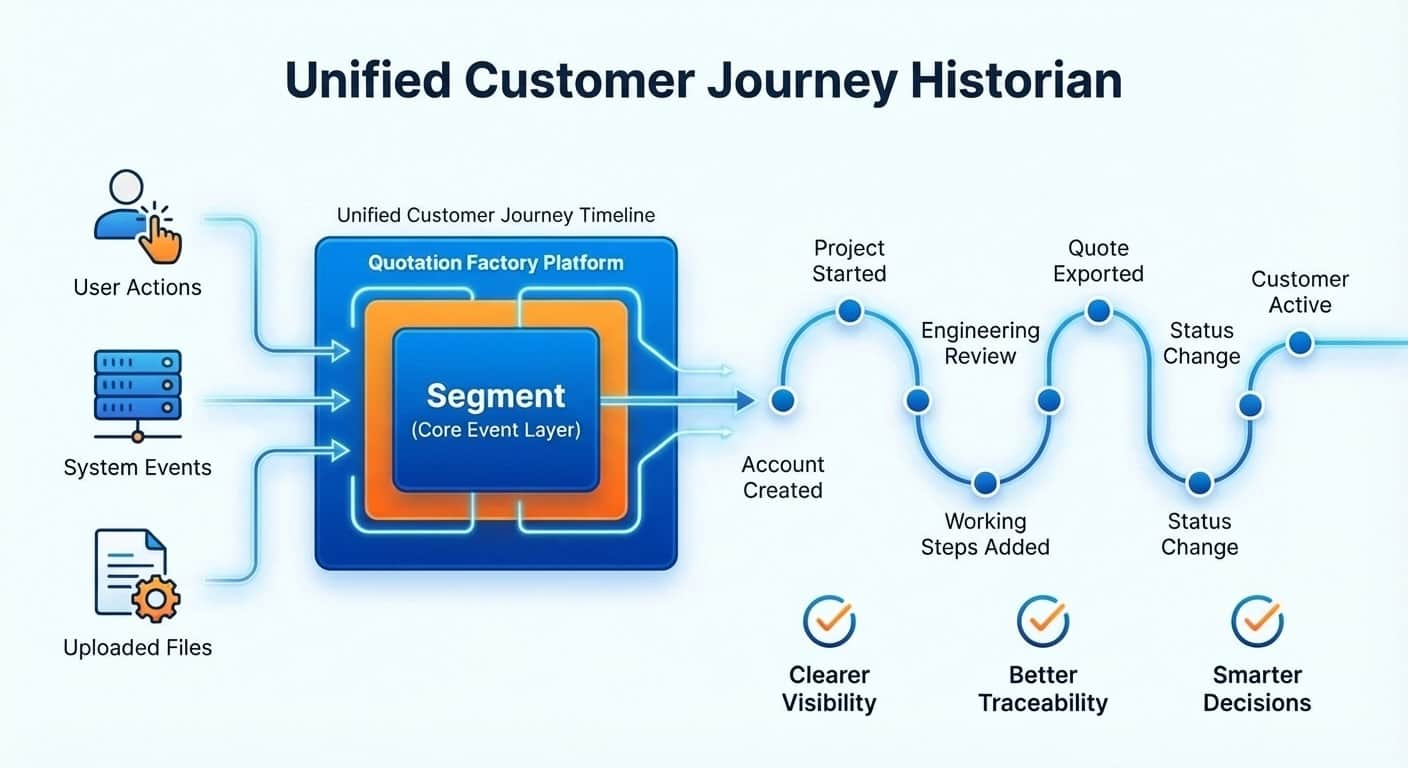
A customer account is created. A user is invited. A project begins. Files are uploaded. Engineering drawings are analyzed. Working steps are added. A project changes status. A quotation is exported. A recognition issue is reported. A project is revisited. A customer becomes active, stalls, grows, or disengages.
Individually, these are system events. Together, they form the real operational and commercial story of a customer relationship.
Our vision is that Quotation Factory should not only support the execution of these steps. It should also provide the intelligence layer that connects them.
Customer Data Management makes this possible by creating a structured, reliable, and reusable stream of meaningful events across the platform.
This turns fragmented product activity into a clear and usable timeline of what happened, for whom, when, and with what result.
Segment as a core component of the Quotation Factory platform
To support this vision, Segment plays a foundational role inside the Quotation Factory platform.
Segment acts as the central event collection and routing layer for relevant customer, project, and operational events generated by both frontend and backend systems. It allows Quotation Factory to capture these events in a consistent format, enrich them with business context, and route them to the right downstream destinations.
This is important because the platform is not defined by one single action. It is defined by a sequence of events across multiple systems and touchpoints.
By using Segment as a core component, Quotation Factory can create a shared event language across the platform. That shared language helps us understand not only what users click, but what customers are actually trying to achieve and how their work progresses through the platform.
In that sense, Segment is not just an analytics integration. It is part of the platform architecture.
It supports:
- consistent event collection across frontend and backend systems
- a common structure for customer, project, and lifecycle events
- governance of event definitions and meanings
- routing of events to internal analytics or customer-specific destinations
- the creation of a unified customer and project history
This makes Segment a foundational building block for what we see as the next generation of Quotation Factory: a platform that combines workflow execution with operational intelligence.
Why Customer Data Management matters for Quotation Factory customers
For companies using Quotation Factory, the value of Customer Data Management goes far beyond reporting.
It creates the foundation for better visibility, better traceability, better responsiveness, and better decision-making.
1. A clearer view of the customer and project journey
Manufacturing companies often work across multiple departments and steps: commercial intake, engineering review, BoM processing, working-step estimation, pricing, output generation, follow-up, and delivery.
When these steps are recorded as structured events, they become part of one connected timeline.
That gives companies a clearer view of:
- when a customer project started
- which actions were taken
- where progress was made
- where friction occurred
- when manual intervention was needed
- how the project moved through its lifecycle
This kind of visibility reduces guesswork and improves coordination.
2. Better operational traceability
In industrial and metalworking environments, traceability is critical.
A structured event history helps companies understand how a project evolved over time. That includes not only final outcomes, but also the important intermediate steps that explain those outcomes.
For example, a company can understand:
- when files were uploaded
- when drawings were processed
- whether recognition succeeded or failed
- whether working-step estimates were manually adjusted
- when a project changed status
- when outputs were exported
This makes it easier to reconstruct history, explain delays, identify recurring issues, and maintain consistency.
3. Faster and more informed customer service
When teams have access to a reliable project and customer history, they can respond faster and with better context.
Instead of manually piecing together what happened, support, sales, and operations teams can work from a structured timeline.
That means they can answer questions more effectively, identify problems faster, and communicate more clearly with customers.
This is especially valuable in metalworking businesses where requests often involve technical complexity, engineering interpretation, and multiple handoffs.
4. Better internal decision-making
Customer Data Management does not only help companies look backward. It also helps them improve how they work.
By identifying event patterns, companies can see:
- where projects tend to slow down
- where manual work is increasing
- which types of requests generate the most friction
- which parts of the process are most reliable
- which customers are highly engaged and which are becoming inactive
That creates a valuable layer of operational insight.
5. A stronger customer experience
One of the biggest long-term advantages of structured event data is the ability to create more transparent customer experiences.
When customer-relevant events are managed intentionally, they can support clearer progress visibility and more proactive communication.
For example, event-driven visibility can help a business communicate:
- that a request has been received
- that engineering analysis has started
- that a project is awaiting clarification
- that manual review was required
- that a quotation package has been generated
This improves trust and helps customers feel informed rather than left in the dark.
Added value for metalworking businesses specifically
Quotation Factory serves companies that operate in industrial and metalworking contexts where quoting, engineering interpretation, and process reliability are deeply connected.
That makes Customer Data Management especially valuable.
For metalworking businesses, the combination of Quotation Factory and Segment can support:
- clearer visibility into complex quoting workflows
- stronger control over project history
- better collaboration across commercial and technical teams
- faster diagnosis of process bottlenecks
- improved service quality for end customers
- preservation of operational knowledge over time
This matters because many industrial businesses still depend heavily on fragmented communication, manual status tracking, and personal knowledge. A structured event layer helps reduce that dependency by turning activity into shared operational memory.
From event tracking to a Unified Customer Journey Platform
The real value of Customer Data Management is not the event itself. It is what the event makes possible.
As this capability matures, it enables Quotation Factory to become more than a quoting platform. It becomes a Unified Customer Journey Platform.
That means:
- one structured model for meaningful events
- one connected timeline across systems and touchpoints
- one basis for analytics, automation, and customer visibility
- one shared language for customer lifecycle understanding
This is a major step forward because it connects workflow execution with customer intelligence.
The Historian: preserving the story behind the work
Another way to describe this vision is through the role of the Historian.
The Historian is the part of the platform that preserves and organizes the story of the customer relationship over time.
It answers questions such as:
- What happened first?
- What changed next?
- Which project or account was affected?
- Who took action?
- Was the outcome successful?
- Where did friction appear?
- Which milestones indicate growth, risk, or the need for intervention?
This is valuable for Quotation Factory internally, but also for the companies using the platform. It creates continuity, clarity, and intelligence across the lifecycle of customer projects.
Looking ahead
The long-term opportunity is not just better analytics. It is the ability to use customer and operational event data as a strategic product capability.
With the right event model and governance, Quotation Factory can continue building toward:
- stronger lifecycle visibility
- more intelligent customer success support
- better internal and customer-facing dashboards
- safer segmentation of customer-specific data
- more proactive service workflows
- a richer and more transparent customer experience
This is why Customer Data Management matters.
It is not a technical add-on. It is a core enabler of a smarter platform.
Conclusion
At Quotation Factory, we see Customer Data Management as a strategic capability that helps connect product activity, operational workflows, and customer lifecycle understanding.
Segment is a core component in that architecture because it allows us to collect, structure, enrich, and route the events that define how customers use the platform and how their projects progress.
For Quotation Factory, this creates a stronger foundation for product intelligence, lifecycle insight, and scalable platform governance.
For companies using Quotation Factory, especially metalworking businesses, it creates tangible value through better visibility, stronger traceability, faster response, and a more transparent customer experience.
That is the broader vision: not only to digitize quoting and engineering workflows, but to build a platform that understands and preserves the customer journey behind them.