Events, Expectations, and Why Your ERP Is Not the Truth
Manufacturing companies love the idea of a “single source of truth”. Most of the time, that means: “Our ERP is the truth.”
But if you really look at how a factory behaves in the real world, that idea quietly breaks down.
In this article I want to offer a different lens:
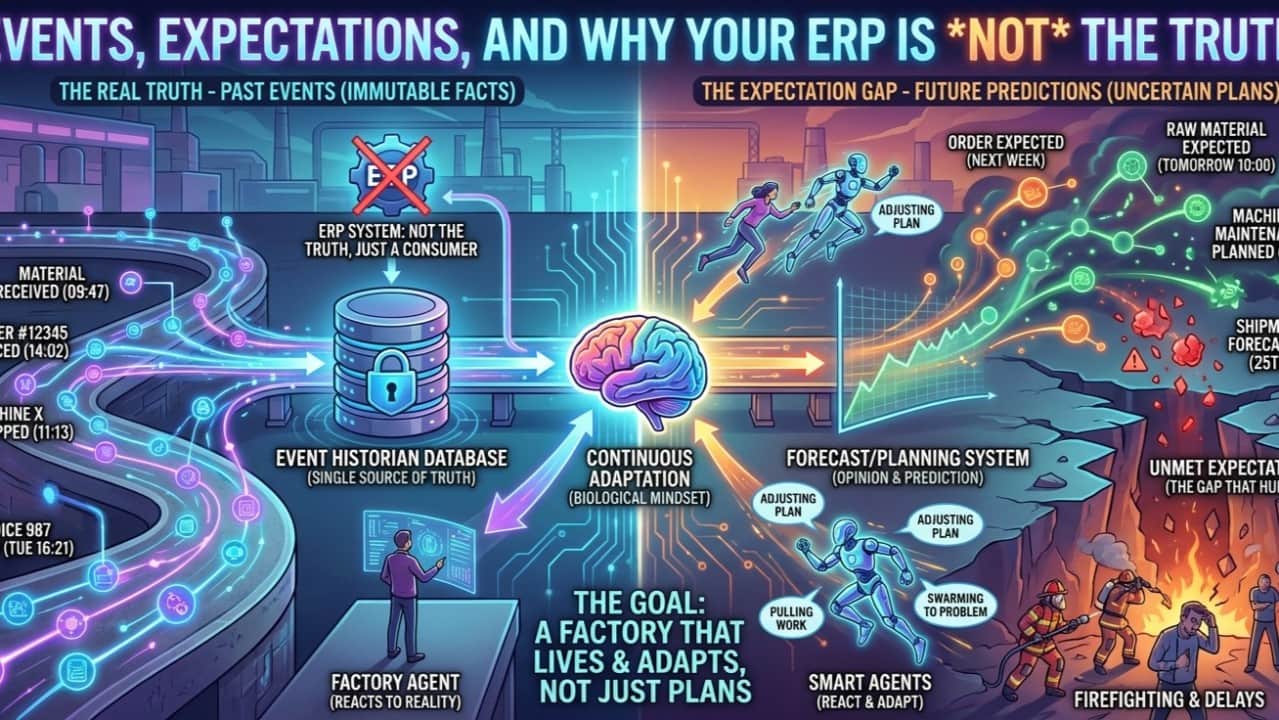
Your only real “source of truth” is what actually happened (events) and what you thought would happen (expectations).
Everything else is just an opinion wrapped in a user interface.
The Myth of the Single Source of Truth
For years we’ve told ourselves:
“If we just get all data into one system, we’ll have control.”
So we push everything into ERP, MES, spreadsheets, planning tools. We treat those systems as the truth.
But systems don’t represent reality perfectly:
- Data is late.
- Data is incomplete.
- Data is interpreted differently by each department.
- And every “single source of truth” sooner or later gets copied into another system anyway.
So you don’t have one truth. You have many partial, delayed, filtered versions of what’s really going on in your factory.
And yet, there is something that is always true…
Events: What Really Happened
In a factory, the only things that are objectively true are events:
- Raw material received at 09:47
- Order #12345 placed at 14:02
- Machine X stopped at 11:13
- Invoice 987 paid on Tuesday at 16:21
An event is something that has happened at a specific point in time. Once it has happened, it never changes.
You can:
- Store it in a database
- Move it between systems
- Analyze it
- Use it to train AI agents
…but the event itself stays the same: “Material arrived at 09:47” will always be true.
That’s why I believe:
A factory’s digital backbone should be built on events, not on systems.
If you structure events well and store them in an “event historian” (a database of everything that has happened), you create:
- A system-independent view of reality
- A solid foundation for integration
- Clean input for reporting, planning, and AI
Your ERP is then not the truth. It becomes one of many consumers of the truth.
Expectations: What You Think Will Happen
So far, this is about the past. But factories don’t live in the past - they live in the tension between:
- What has happened
- What we expect to happen
That’s where the second concept comes in: expectations.
If an event is “invoice paid”, an expectation is “invoice expected to be paid on Friday”.
Some examples:
- Order expected next week
- Raw material expected tomorrow before 10:00
- Machine maintenance planned on Thursday
- Shipment forecasted to leave on the 25th
These are future events that may or may not become reality. They come from:
- Predictions and forecasts
- Commitments with suppliers or customers
- Schedules
- Human planning and decisions
And this is where it gets interesting…
The Gap That Really Hurts: When Expectations Don’t Become Events
Most factories mainly react to what happens:
- Machine down → react
- Rush order → react
- Material arrives → react
But there’s a hidden, far more expensive layer:
The things you expected to happen… that never happened.
For example:
- You expected raw material at 10:00 → it doesn’t arrive
- You expected an order to be confirmed → it doesn’t happen
- You expected a payment on Friday → it’s delayed
If you don’t systematically monitor the gap between:
- Expected events
- Actual events
…then you’re always late. You only see the problem once it’s already painful:
- Planning is ruined
- Lead times explode
- WIP piles up
- Your people are firefighting
A modern, event-driven factory does both:
- Reacts to what does happen
- Reacts to what should have happened, but didn’t
That second one is where you win or lose on reliability, lead time, and trust.
You Can’t Plan Away Uncertainty
There are two philosophies you can use to run a factory:
- Technocratic mindset → “If we plan hard enough and throw enough tech at it, we can eliminate uncertainty.”
- Biological mindset → “The world is uncertain. Let’s design the system to live with and adapt to that uncertainty.”
Traditional planning systems live mostly in mindset #1:
- Heavy forecasts
- Rigid schedules
- Many assumptions about the future
- Trying to reduce variability as much as possible
Of course, some planning is necessary. But look at biological systems:
- Your body is constantly changing. The cells you’ll have in six years are not the ones you have today.
- Environment, inputs, threats, resources - all keep shifting.
- The system survives by continuously adapting, not by freezing a perfect plan.
What if your factory behaved more like that?
Agents: A Factory That Reacts Like a Living System
Imagine your factory as a network of agents:
- Some are people
- Some are software
- Some are machines
All of them:
- See events (what just happened)
- Know the expectations (what was supposed to happen)
- Have a shared overall goal (flow, delivery reliability, profit, etc.)
Their job is simple:
Continuously decide: “Given what has just happened and what we expected, what is the best thing to do right now?”
This is much closer to how quick response manufacturing (QRM) and pull systems work on the shop floor:
- You don’t blindly push orders through the system “because it’s in the plan”
- People (and systems) pull work based on the latest reality
- Teams “swarm” to keep flow moving and waste low
Event-driven, agent-based architectures are the digital equivalent of that.
You’re not trying to freeze the world in a perfect plan. You’re building a factory that stays agile – highly adaptable – as the world changes around it.
So What Does This Mean in Practice?
You don’t have to throw away your ERP or planning tools. But you do have to change how you think about truth and control.
- Stop treating ERP as the truth. Start treating it as a consumer of the truth.
- Capture events in a structured, system-independent way. What happened, when, and where?
- Make expectations explicit and visible. What do we think will happen, and when?
- Continuously compare events vs expectations. Where are we on time? Where are we late? Where did reality deviate from the plan?
- Design processes and agents to react to deviations. Not only to disruptions, but also to “silence” - the things that should have happened but didn’t.
Do you still plan? Of course. But you:
- Plan where planning truly adds value
- React and adapt where uncertainty is unavoidable
That’s the balance.
One Simple Thought to Leave You With
Summed up very simply:
- Events = what has happened
- Expectations = what you think will happen
Maybe your factory doesn’t become better by planning more, but by planning only where it matters…
…and becoming much smarter at responding to what actually happens (and what surprisingly doesn’t).
If this way of thinking resonates with you – events, expectations, and factories that behave more like living systems than frozen spreadsheets – then this is exactly the journey we’re exploring with manufacturers right now.
Curious how this would look in your environment? Start by asking a simple question internally:
“Where do our expectations quietly fail… and who notices too late?”
That’s where your real leverage is.