Fit2Train (part 3) - Decisions Are Your Real Production System

Why High-Mix Manufacturing Doesn’t Fail Because of Variability - but Because It Can’t Learn
By Wim Dijkgraaf Founder & CEO, Quotation Factory
High-mix manufacturing is usually explained in physical terms: machines, capacity, bottlenecks, and material flow.
And yes - those things matter.
But in a recent Fit2Train live stream, I argued something that often feels uncomfortable at first, yet becomes impossible to ignore once you see it:
In high-mix manufacturing, your real production system is not your machines. It is the way decisions are made, revised, and remembered.
That distinction matters if you want your organization to scale, learn, and eventually use AI in a meaningful way.
Machines are visible. Decisions usually aren't.
Most high-mix manufacturers understand their physical system reasonably well:
- You know how material flows
- You know where capacity sits
- You know which machines are bottlenecks
- You can draw it, measure it, and improve it
But alongside that visible flow, there is another system at work - one that almost no organization has designed explicitly: The flow of judgment about what should happen next.
Every day, the organization is flooded with situations like:
- Do we run this order now or later?
- Can this job be squeezed in?
- Do we wait for engineering, or proceed with risk?
- How much deviation is acceptable this time?
These are not side conversations.
This is how production actually happens in high-mix environments.
Yet this decision flow is rarely mapped, measured, or treated as a system.
What happens when judgments leave no trace?
Here’s the pattern that repeats across many high-mix companies:
- Decisions are made locally
- By planners, team leads, work preparation
- Often by “the person who knows”
That can be efficient in the moment.
But it is also fragile.
Why?
Because those judgments are:
- Made under time pressure
- Adjusted under customer pressure
- Rarely written down as explicit assumptions
- Detached from their context as soon as the moment passes
There is no durable memory of what was believed and why.
So the next time a similar situation appears, the organization decides again - roughly the same way - without knowing whether the last decision was actually a good one.
Which leads to a painful but accurate observation:
Many high-mix organizations only learn if someone happens to remember.
That’s not a learning system. That’s dependence on individuals.
Winning without understanding why
Imagine a sports team with no explicit game plan.
They improvise. They rely on experience. They sometimes even win - often.
The real problem isn’t losing.
The real problem is this: They don’t know why they won.
So they don't know:
- What to repeat
- What to change
- What was skill
- And what was luck
Many high-mix organizations operate exactly like this:
- High effort
- High experience
- High improvisation
- Low shared learning
Not because people don’t want to improve - but because beliefs about what should happen are never made explicit, and therefore never evaluated.
Treating judgment as flow
Here’s the shift that changes the conversation:
What if we treated judgments about what should happen with the same seriousness as material and capacity?
What if:
- Assumptions were stated explicitly upfront
- What actually happened was captured as evidence
- Mismatches were recognized as signals, not failures
- Learning happened during operations, not months later
This is not about:
- Adding more rules
- Removing autonomy
- Eliminating improvisation
In fact, it’s the opposite.
You can only improvise well if you know what you’re deviating from.
Without a clear baseline belief, every deviation looks the same - and teaches nothing.
Beliefs, evidence, and misalignment: the learning loop
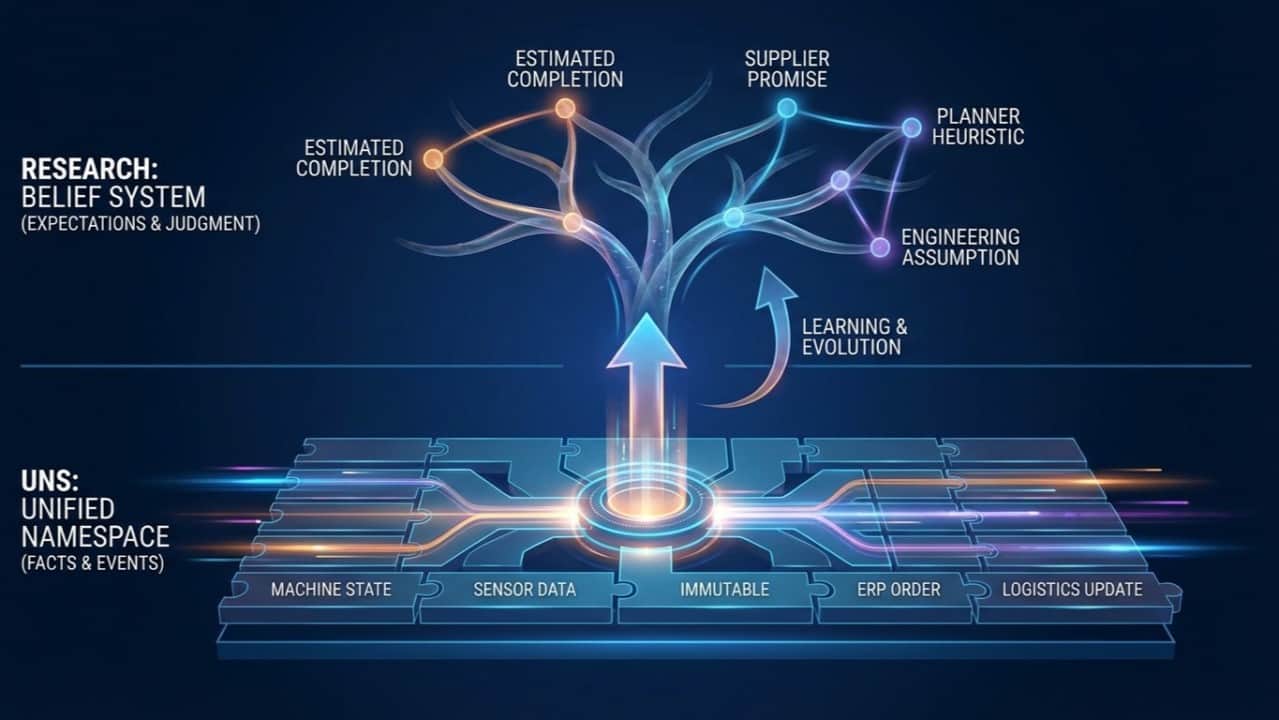
In every high-mix organization, three things already exist - whether you name them or not:
- Beliefs about what should happen Lead times, availability assumptions, promises, plans
- Evidence of what actually happened Orders arriving, machines stopping, jobs finishing
- Moments of misalignment The realization that reality didn’t match the belief
Today, those beliefs are scattered:
- In ERP systems
- In spreadsheets
- In people's heads
- In informal conversations
Evidence is often captured - but rarely compared back to the belief that existed at the time.
And without that comparison, learning collapses.
Evidence alone teaches nothing. Only when reality contradicts a belief does insight emerge.
Why this determines scale - and AI
If assumptions and judgments remain implicit:
- High-mix keeps relying on heroes
- Complexity grows faster than understanding
- Improvements feel temporary and fragile
But when judgments are treated as an explicit, evolving flow:
- Improvisation becomes explainable
- Experience becomes transferable
- Learning becomes structural
Not by slowing things down - but by creating rhythm between belief, reality, and revision.
Only then do you create something essential:
An environment where AI can actually contribute - because there is explicit belief, grounded evidence, and visible learning.
Without that, AI just accelerates guesswork.
The core insight
If you remember one sentence from this article, let it be this:
High-mix manufacturing does not fail because of variation, but because beliefs about what should happen are not made explicit and therefore cannot be learned from.
So I’ll leave you with the same question I ended the live stream with: Which judgment in your organization keeps recurring - without making you collectively smarter each time it happens?
That’s where real learning begins.