High Mix Is Not Your Problem. It's Your Advantage.
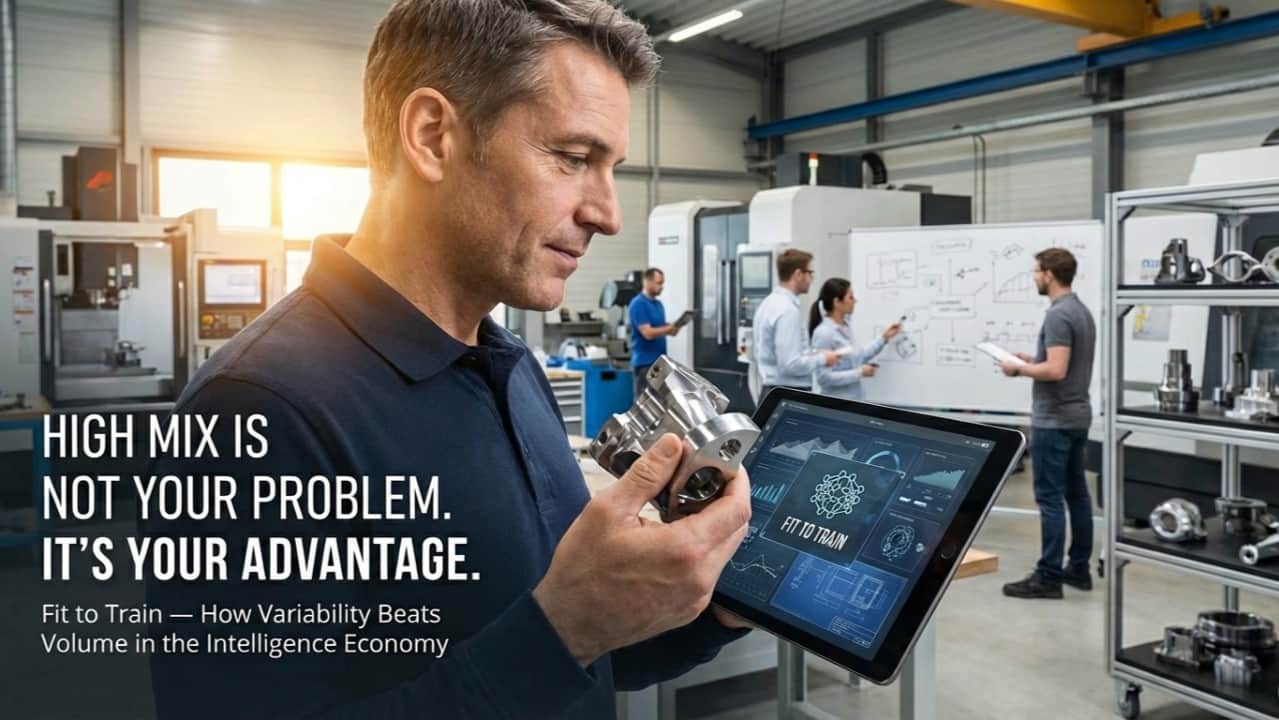
High mix is your advantage, not your problem. Intelligence grows from contrast, not repetition-high-mix environments force faster learning because bad decisions hurt immediately. The key is treating your factory as a learning system that gets smarter with every decision, building institutional memory that scales through automation, and capturing judgment in algorithms so knowledge compounds rather than resets with each new person or product. What if high mix doesn't hold you back, it just means bad decisions hurt faster?
If you run a high-mix manufacturing business, you’ve heard this story before.
You’re told that:
- automation works better elsewhere
- AI needs volume and repetition
- your operation is “too complex”
- once things stabilize, then real improvement can start
In other words: high mix is framed as a disadvantage you need to overcome.
Most owners don’t fully believe that story. But after hearing it often enough, they start to accept it.
That’s a mistake.
The reality you live every day
High-mix, low-volume manufacturing doesn’t fail because people aren’t working hard enough. It struggles when decisions stop scaling.
Think about your day:
- Every quote is a judgment call
- Every order introduces new trade-offs
- Engineering, planning, and execution constantly adapt
- Exceptions are normal, not rare
Very little repeats exactly the same way.
That’s not a lack of maturity. That’s the nature of your business model.
The false assumption behind most “solutions”
Most digital tools, automation concepts, and AI narratives are built on one assumption:
Intelligence grows from repetition.
That assumption comes from high-volume environments:
- stable routings
- predictable demand
- standardized decisions
But high mix doesn’t work that way.
And here is the crucial insight:
Intelligence does not grow from repetition. It grows from contrast.
From decisions that look similar - but aren’t. From understanding why this case was handled differently from the last one. From making trade-offs explicit instead of hiding them in experience.
Why high mix is actually fit to train
High-mix companies may not repeat products. But they repeat decisions:
- Can we accept this order responsibly?
- Where do we absorb risk-cost, lead time, or capacity?
- What can still change, and what cannot?
- Which exception is acceptable this time?
These are decision-rich environments.
And decision-rich environments are exactly where:
- people learn fastest
- judgment is refined
- and real intelligence is formed
Low-mix, high-volume systems train optimization. High-mix systems train judgment.
In an economy where uncertainty is structural - not temporary - judgment matters more than ever.
A different way of thinking (from first principles)
This requires stepping outside familiar categories.
Not:
- ERP vs MES
- planning vs execution
- automation vs people
But first principles like:
- You don’t eliminate variability - you design how the system responds to it
- Autonomy without intelligence only accelerates mistakes
- High mix is not a temporary inefficiency - it is a structural model
From that perspective, the real bottleneck in high-mix manufacturing is rarely machines or labor.
It is decision-making that does not scale.
Why I started "Fit to Train"
I started the Fit to Train podcast and live stream series for one reason: To challenge the idea that high-mix manufacturers are behind.
And to explore a different truth:
High-mix environments are not unprepared for the intelligence economy. They are already living in it.
The series is not about tools. Not about quick wins. Not about AI hype.
-
It is about:
-
clearer thinking
-
better mental models
-
and making sense of a reality you already know well
If this resonates
If you run -or advise- a high-mix, low-volume manufacturing business, this series is for you.
Not because it promises easy answers. But because it takes your reality seriously.
High mix is not something to “grow out of.”
It may be exactly what makes your business fit to train for what comes next.
👉 Follow Fit to Train - How Variability Beats Volume in the Intelligence Economy 👉 Watch the episodes. 👉 Join the discussion.
Because the future of manufacturing will not belong to the most repetitive systems.
It will belong to the ones that learned how to decide well-under variability.