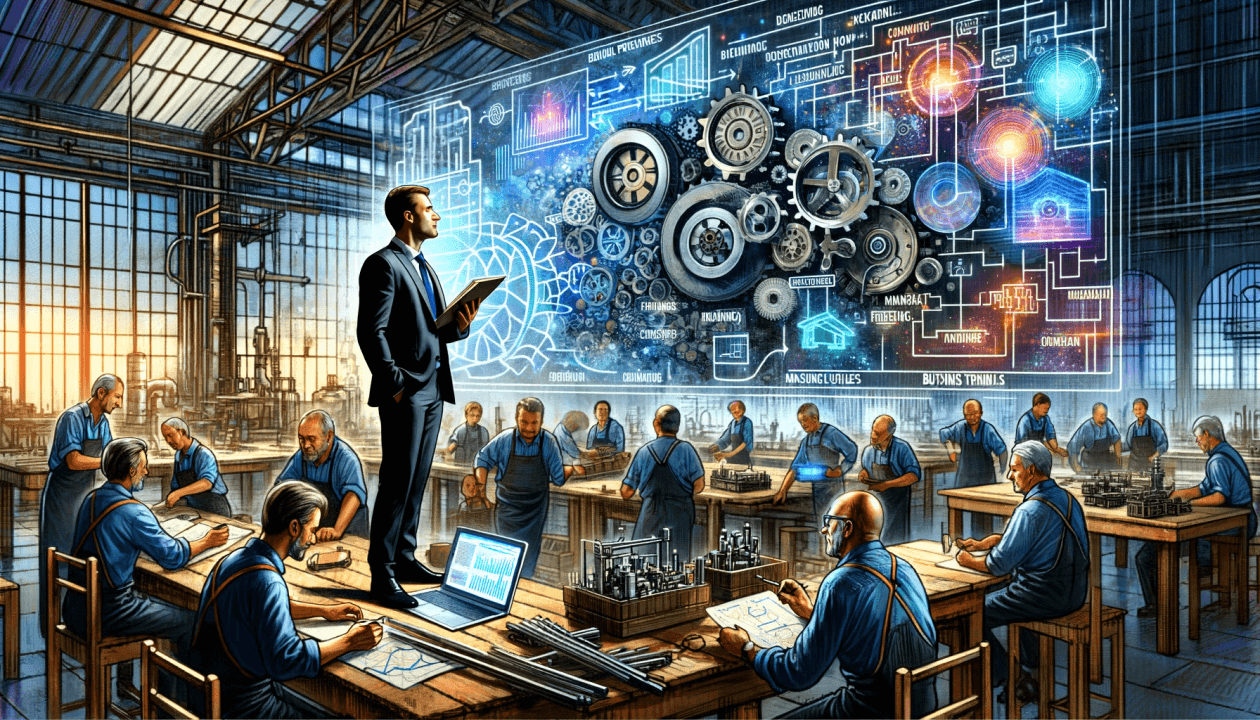
The metalworker's conundrum

How a monolithic, on-premise ERP system hindered a company's transition to more agile, cloud-based solutions in the Industry 4.0 era.
The Beginning
Once nestled in a bustling industrial district, there stood the proud headquarters of "ForgeTech Metals," a renowned metalworking company. At its helm was Jacob Sterling, a visionary owner who had inherited the business from his father. Under Jacob's leadership, ForgeTech had grown substantially, but he knew to stay ahead, he needed to embrace the digital transformation of the industry.
The Decision
Jacob invested heavily in an Enterprise Resource Planning (ERP) system. This on-premise solution was a behemoth of software, intended to integrate all facets of the business - from supply chain management to human resources. Jacob envisioned this system as the digital backbone of ForgeTech, a single, unifying force in an increasingly complex industry.
The Turning Point
As the fourth industrial revolution unfolded, new paradigms like "Industry 4.0" and "The Smart Factory" began to dominate. This era was marked by a move towards agility, flexibility, and interconnectedness - hallmarks of best-of-breed systems and cloud-native applications. Jacob watched as competitors began to integrate these nimble, cloud-based solutions, leveraging APIs and Event Driven Architectures to stay ahead.
He started integrating some best-of-breed cloud solutions at ForgeTech, hoping to catch up. These systems offered incredible features - real-time analytics, remote access, and seamless updates. However, Jacob soon faced a harsh reality.
The Realization
The monolithic ERP system, with its cumbersome on-premise infrastructure, was like an anchor. It was rigid, closed off, and incompatible with the cloud-based, API-driven solutions Jacob was now eyeing. The more he tried to integrate his new, agile tools, the more apparent the mismatch became.
His ERP couldn't communicate effectively with the cloud-based systems, creating data silos and operational inefficiencies. The lack of a Unified Namespace (UNS) and the inability to adapt to an Event Driven Architecture only compounded the problems. Jacob's vision of a seamlessly integrated digital ecosystem was crumbling.
The Reflection
Jacob found himself at a crossroads. He reflected on the decisions that led him here. The ERP system, once a symbol of progress, now represented a costly mistake - a relic of a past era. It was a sobering realization for a man who had always prided himself on looking forward.
The Resolution
Jacob knew that to stay relevant in the Industry 4.0 era, he had to make a bold move. He began exploring ways to gradually phase out the ERP system, looking into more modular, cloud-native solutions. He started small, implementing systems that could coexist with the ERP while planning for a future where ForgeTech's digital architecture would be as agile and innovative as its metalworking.
It was a journey fraught with challenges, but Jacob Sterling was determined. He had learned a hard lesson about technological adaptability, but it was a lesson that would ultimately redefine ForgeTech Metals and secure its place in the new industrial landscape.
The End
Jacob's story is a cautionary tale of technological evolution and the importance of adaptability in a rapidly changing world.