The Smart Factory Signal: It's Not Token Burn, It's Where the Tokens Burn

By Wim Dijkgraaf, founder & CEO of Quotation Factory
Over the past few months, I have literally fallen off my chair more than once.
Not because of a new dashboard. Not because of a polished demo. Not because an existing software vendor added yet another AI feature.
But because something far more fundamental has happened: the quality jump in the latest AI models, combined with the way they can use tools, systems, and codebases, has made one thing crystal clear to me. We have entered a new phase. Not the next step in digitization, but a new operational reality.
I genuinely believe we are at the beginning of an intelligence explosion.
And for manufacturing companies, that means we need to relearn how we look at work, software, innovation, and even financial steering.
Why I'm writing about this now
I recently did a livestream about an article I published on our website. That article was about token consumption: a topic that may sound technical and financial at first, but is actually much bigger than that.
Because token consumption is not just a cost item. It can become a signal. An indicator. Perhaps even one of the most interesting new ways to assess how intelligently a company actually operates.
Not because high token usage is automatically good.
But because where tokens are consumed increasingly tells you something about the maturity of the business.
That is the core idea for me.
First, this: openness is not optional
Before I get into AI, I want to make one other point.
I recently criticized a number of initiatives in manufacturing that generate a lot of language, collaboration, and positioning, but where the actual substance is difficult to find or insufficiently concrete.
My position is simple: if we say we want to learn together and accelerate together as an industry, then openness must come with that. Not just marketing. Not just manifests with abstract principles. We need to show what we are doing, what works, what does not, which choices we make, and where the real lessons are.
That is exactly why I deliberately try to be transparent about how we build, how we think, and how we apply AI inside Quotation Factory.
If in 2026 we still act as if operational innovation should remain mysterious, then as an industry we are slowing ourselves down.
What really changed over the past two months
Many people still think of generative AI as something that is mainly useful for text analysis, summaries, marketing content, or a first draft of a document. That picture is already outdated.
What happened in early 2026 is that new models from companies such as OpenAI and Anthropic reached a level where they became much better at reasoning over longer time horizons, holding context, using tools, and carrying out work independently within a clearly defined objective.
That is already important on its own.
But the real acceleration happens when you combine that with two other developments:
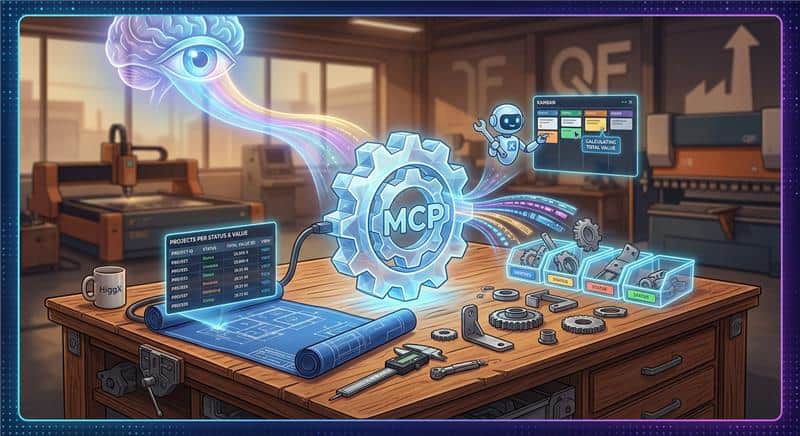
- more and more software systems now support protocols that allow AI models to safely call tools and retrieve data;
- even when systems do not yet support such a protocol, the latest models can often read public API documentation and build the required integration logic themselves.
In practice, that means AI no longer just "thinks along." It acts.
And once AI can act, your entire view of automation starts to shift.
The difference between the change organization and the going concern
To understand why this is so significant, I always distinguish between two worlds inside a company.
The first is the change organization. That includes innovation, projects, new propositions, process improvements, and system changes.
The second is the going concern. That is the daily operation: marketing, sales, support, customer success, integration management, delivering on SLAs, customer contact, follow-up actions, and monitoring.
Those two worlds are connected. What you develop in the change organization ultimately has to land in the going concern. That is where it has to create value.
That is exactly where AI becomes interesting.
What we are seeing at Quotation Factory in daily operations
Quotation Factory has always been a digital and data-first company. For years, we have worked fully online. Almost all our communication flows through systems that leave a trace: CRM, support software, meeting transcripts, platform events, usage data, and online interactions.
That means we have an unusually rich data stream.
And that is precisely why AI agents can now deliver real value inside daily operations.
A concrete example: suppose someone in the customer success team unexpectedly drops out two weeks earlier than planned. That immediately creates an operational problem. Meetings must be reassigned, customers need to end up with the right people, context cannot be lost, and colleagues need to understand the situation quickly.
In the past, you solved that with a lot of manual work, a lot of alignment, and a lot of risk of losing information.
Now, connected systems and AI agents can take over a large part of that work. Based on calendars, previous meeting transcripts, customer history, and knowledge of who in the team has which specialism, an agent can suggest who should take over which meetings, why that makes sense, what the background of the account is, and which additional information matters.
The business simply keeps moving.
That is not only more efficient. It is also higher quality.
Another example is how we process prospect conversations. Meetings automatically generate transcripts and summaries. We then run analyses on top of those, linking the content to profiles, impact hypotheses, and next steps. Based on that, tasks are generated, risks are identified, and follow-up actions are automatically assigned to the right people.
The keyboard is no longer the central instrument.
Not because people disappear, but because documentation, structuring, classification, and follow-up are increasingly handled by specialized AI processes.
What is happening in the change organization is at least as profound
The impact in the change organization is at least as large, perhaps even larger.
Right now, we are actively reshaping Quotation Factory into an AI-first company. That includes reorganizing our codebase so it becomes more manageable for AI-driven development.
And here too, something fascinating is happening.
Because our platform is event-driven, we capture context whenever something goes wrong. Think of an error in processing a CAD model or a specific drawing variant that is not yet properly supported. The moment that happens, an event is generated. That event contains context: which customer was involved, which file was involved, what exactly went wrong, and under which technical conditions it happened.
An agent can then subscribe to that event.
That agent can automatically create a ticket, analyze the issue, fetch the relevant files, determine where in the codebase to look, first write a failing test, then search for a solution, rerun all tests, and eventually create a pull request that still needs to be approved by a human.
From there, the regular deployment flow can take over.
What emerges here is a closed loop in which software issues are resolved faster, more consistently, and more scalably, while the system simultaneously learns from new real-world variants.
For our customers, that matters enormously. They are constantly confronted with inputs that can never be fully standardized or predicted. The reality of manufacturing is messy, diverse, and always moving. That is exactly why this is so powerful.
The real shift is not the technology, but behavior
What strikes me perhaps most of all is that the biggest change is not technical but human.
You can rationally understand that AI is powerful. You can watch presentations, watch videos, read benchmarks, and study use cases. But the penny only really drops when you start organizing your own work differently.
That is where the discipline lies.
In almost everything we do now, we have to actively ask ourselves: are we still doing this the old way because it feels familiar, or are we redesigning it from the question of how AI can support, accelerate, or take it over?
That is not a small change. That is behavioral change.
And in my experience, that is the real threshold for companies that say they are working with AI, but in practice still operate mostly according to the old model.
Now the financial question: why token burn matters
And that brings me to the heart of my original article.
AI costs tokens. The moment you deploy AI seriously inside your company, a new variable cost component appears. Where work used to be organized mainly through people, licenses, and fixed contracts, you now add a dynamic stream of token consumption.
That immediately affects how you think about cash flow, cost structure, and operational steering.
But that is not even the most interesting part for me.
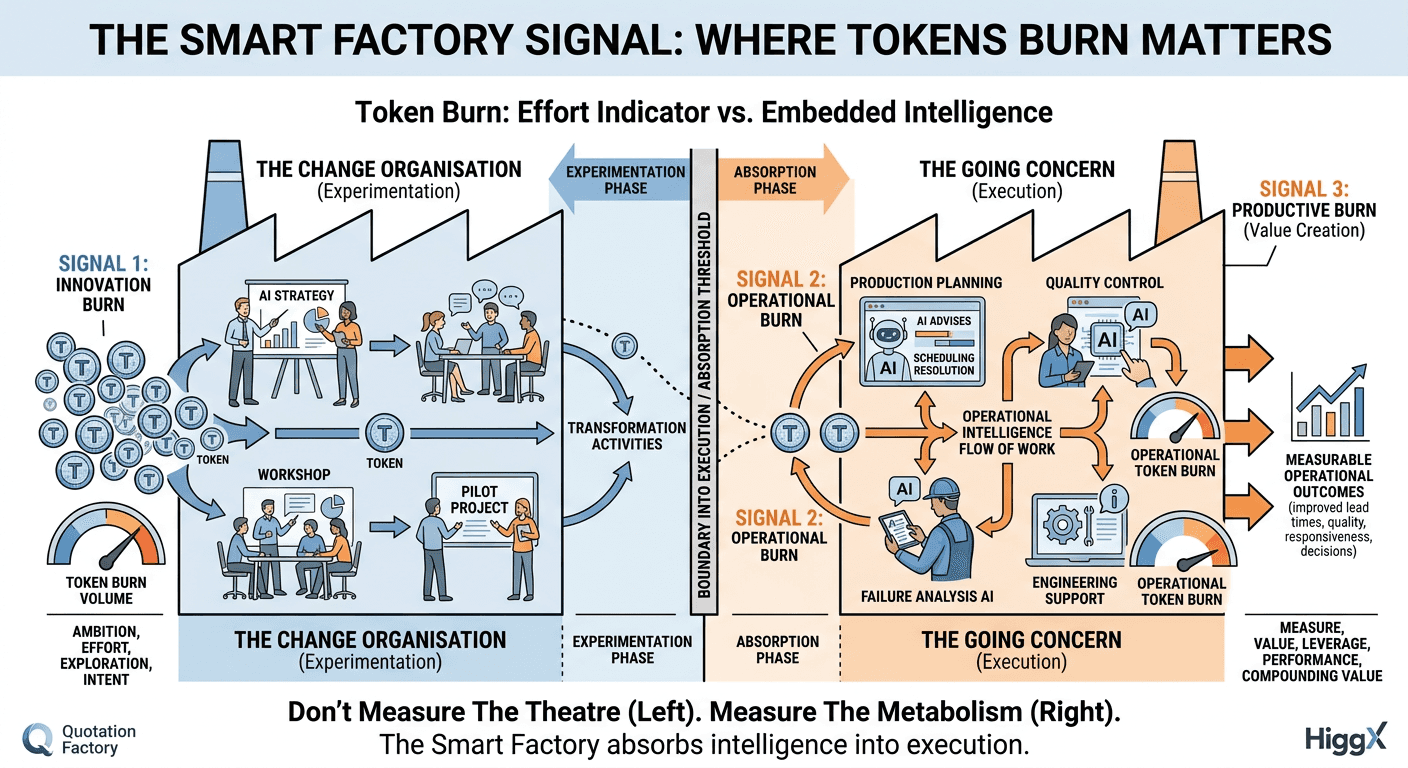
What is truly interesting is that token consumption also reveals where intelligence is actually at work inside the company.
If most of your tokens are being consumed in the change organization - experiments, innovation, analyses, prototypes, development work - then that mostly tells you something about your innovation activity.
That is valuable. It may be a sign that you are moving fast, learning, and building.
But the more exciting question is what happens in the going concern.
When token consumption becomes visible in planning, support, engineering, customer follow-up, quality assurance, and day-to-day operational processes, then AI is no longer just increasing your capacity to innovate. It is starting to change your operational metabolism.
And that is exactly where I see the smart factory signal emerging.
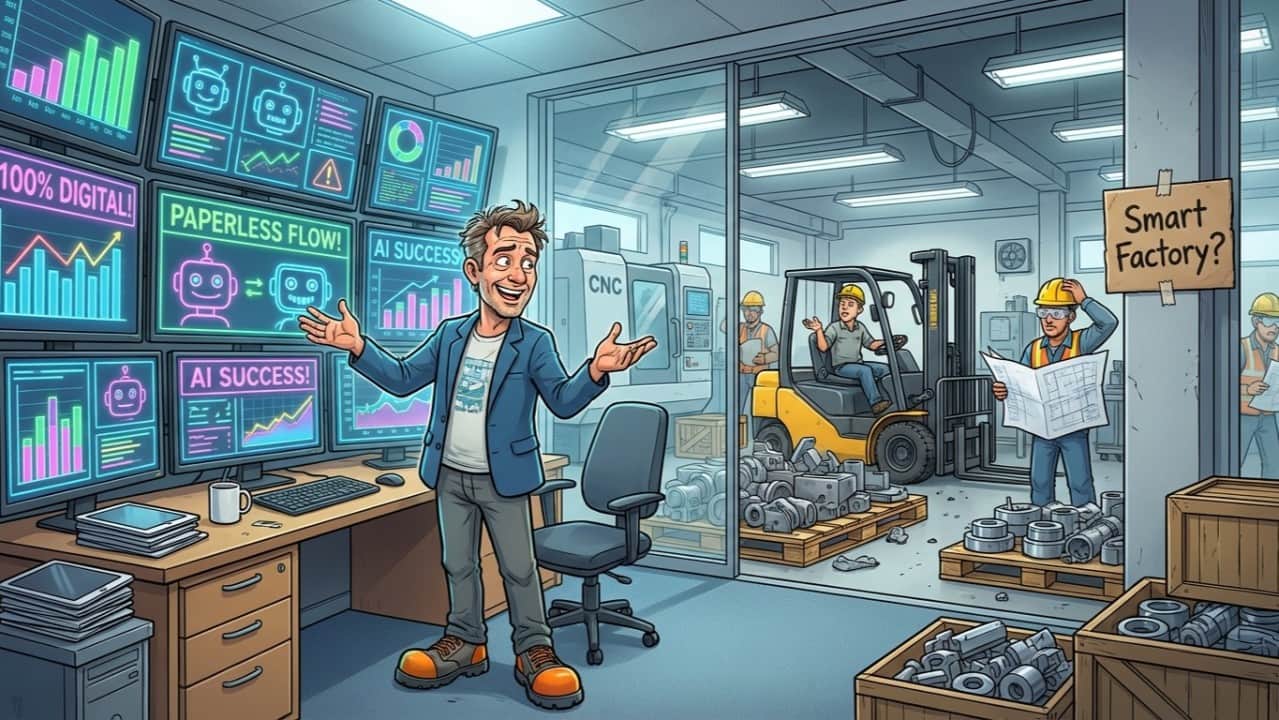
Not in whether you use AI.
Not in how many pilots you run.
Not in how much marketing you organize around AI.
But in this question: where inside your business is intelligence actually being consumed?
From hype indicator to performance indicator
I believe token consumption will become a new indicator for many companies in the near future. Not as an isolated number, but as a pattern.
Where do the tokens go? Into experiments? Into support tasks? Into the core of operations? Into self-improving closed loops? Into processes that directly contribute to customer value, speed, quality, and scalability?
If you learn to read that pattern well, you get a much more interesting picture of company maturity than most traditional digitalization labels can give you.
That does not mean more token consumption is always better. Just as higher energy consumption does not automatically mean a better production process.
But the distribution of that consumption, the quality of the application, and the relationship to tangible business output will tell us a great deal.
To me, that is a much more serious way to think about the smart factory than the usual superficial discussions.
My conviction
My conviction is that we are only at the beginning.
The companies that win in the age of AI will not necessarily be the ones shouting the loudest that they are "doing something with AI." They will be the ones that embed intelligence most deeply into execution.
Yes, that requires technology.
But even more, it requires openness, discipline, operational design capability, and the willingness to fundamentally change your own behavior.
That is what we are going through ourselves at Quotation Factory right now.
And that is exactly why I will keep writing about it, sharing what we learn, and making it visible.
Not because we already know everything.
But because I believe this is the conversation manufacturing needs to have right now.