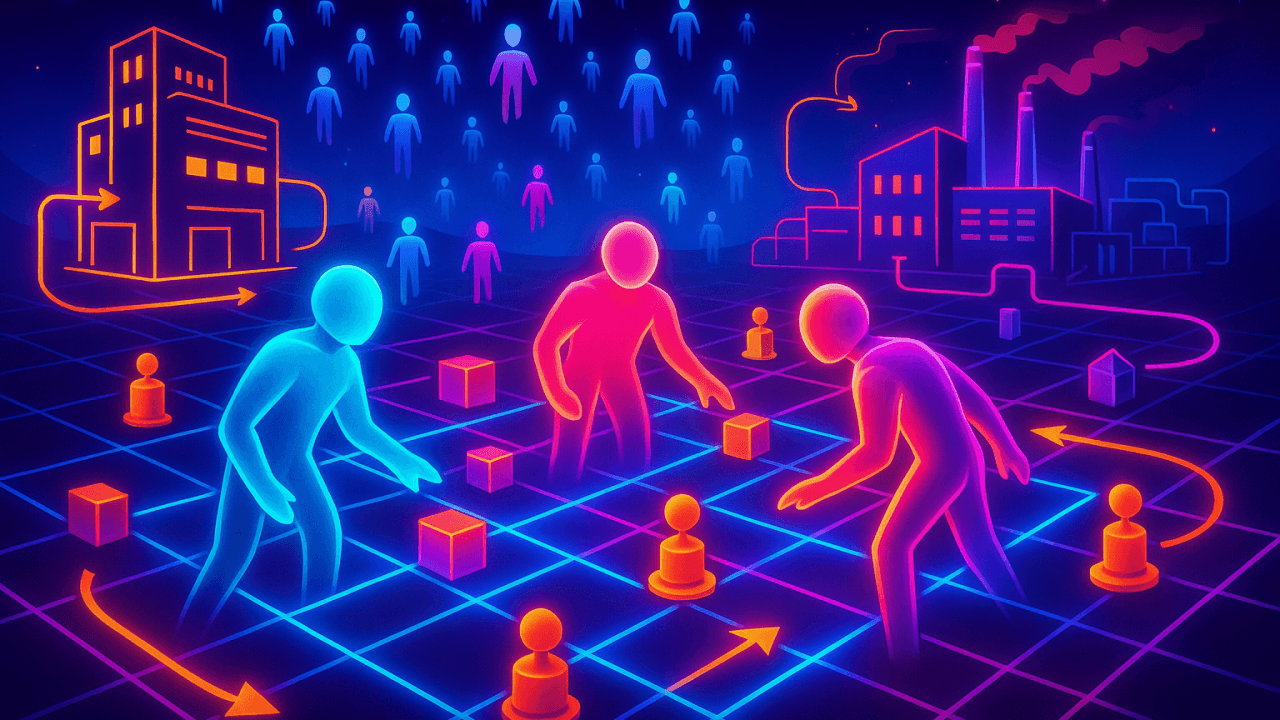
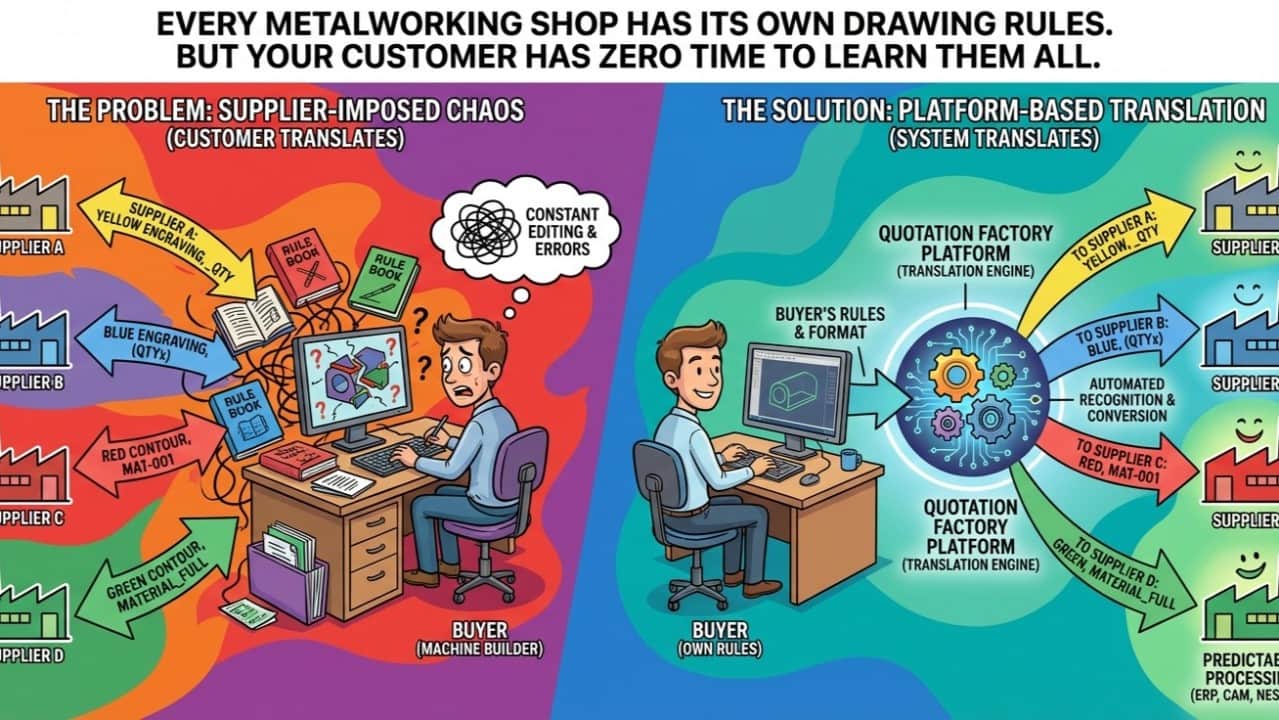
The Supply Chain as a Game Engine: Not a Metaphor, a Roadmap
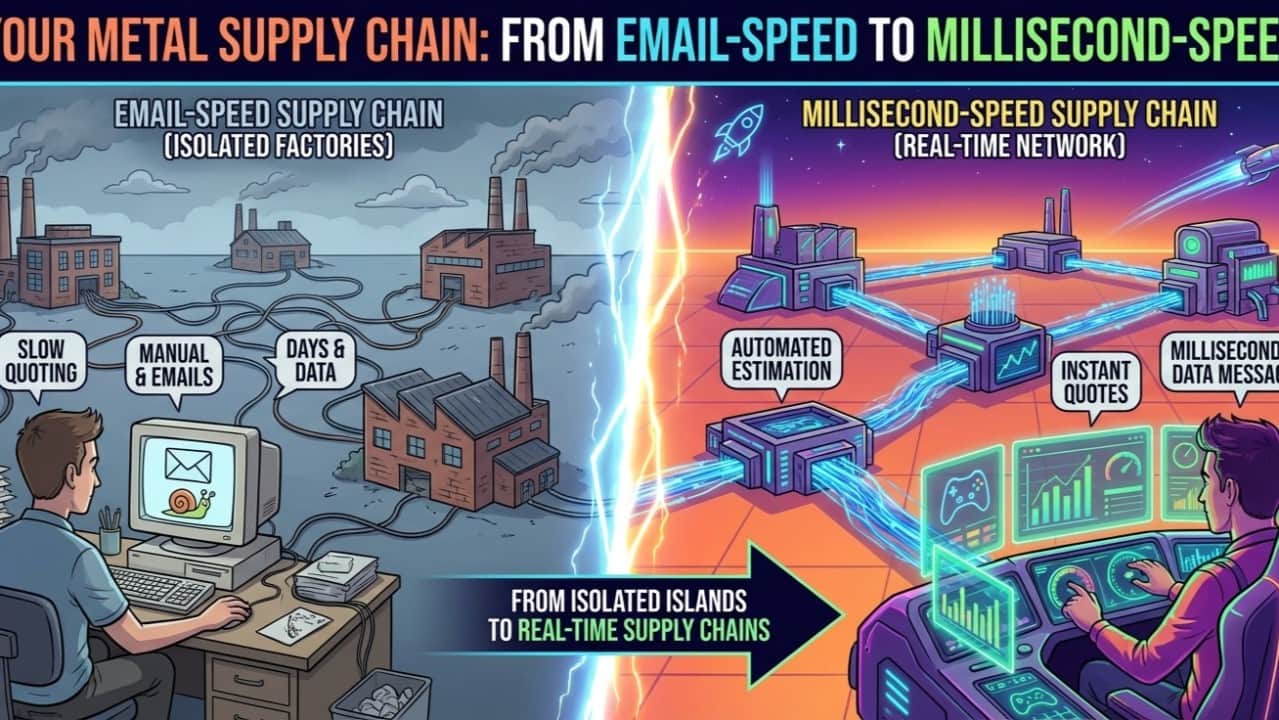
Your metal supply chain still moves at the speed of email. Your customers now expect the speed of online gaming.
That contrast has been on my mind for years.
In a recent live stream, I showed the video that originally inspired how we built Quotation Factory’s architecture: a behind-the-scenes look at how Microsoft scaled Halo to millions of players, with hundreds of thousands of updates per second across thousands of servers, all in real time.
The key takeaway from that video wasn’t “wow, cool game.” It was: this is exactly how a metalworking supply chain should behave.
And that is what we’re quietly building.
The real problem: it’s not “slow quoting”, it’s isolated intelligence
Most metal companies describe their pain like this:
- “Quoting takes too long.”
- “We are too dependent on a few key people.”
- “There’s no time to standardize; we’re constantly firefighting.”
Those are all real symptoms. But they’re not the root cause.
The deeper problem is this:
Every factory operates as a digital island.
Even if you have “digital tools”, your actual intelligence – experience, rules of thumb, pricing logic, production know-how – is still locked:
- inside one factory
- in Excel sheets, custom ERP configurations, or people’s heads
- behind authorization models that assume factories should never really “talk” to each other
Information travels in days and emails, while your decisions actually need to move in milliseconds and data messages.
That’s the gap we’re closing.
What we demo’d: from drawings to a complete quote in seconds
In the live stream, I walked through a simple but powerful flow that already runs today on our platform.
- Upload the reality I upload:
- Automatic understanding of the request The platform:
- Automatic estimation With one click (which could also be fully automated), the system estimates:
Today, most companies see this as “inside the four walls of a factory.”
But that’s only chapter one.
Under the hood: a game engine for metal
Here’s where the Halo story comes back.
The architecture behind that game was built to support:
- huge numbers of actors (players, objects, events)
- all interacting in real time
- across large, distributed infrastructures
To achieve that, Microsoft developed a cloud-optimized framework based on the actor model: Orleans.
We applied the same architectural principles as the backbone of Quotation Factory.
In our world, that looks like this:
- Every factory has a digital twin as an actor in the cloud.
- Every estimator, every buyer, every quote, every production order, every BOM item, every nesting plan – all are actors.
- All those actors can activate when needed, do their job, exchange information, and deactivate when idle.
During the live stream, I showed a real-time dashboard of our production environment:
- 60+ factories active right now
- thousands of actors representing real entities in the physical and digital world
- an average latency around 60 milliseconds That means: From a pure technology perspective, these factories are only a few milliseconds away from each other’s intelligence and capabilities.
The only thing still separating them?
Authorization and commercial agreements. And we’ve already built the mechanisms to open that up safely where it makes sense.
From isolated factories to real-time supply chains
Today, we can already set up relationships like:
- “Factory A and Factory B are preferred suppliers for each other.”
- “This metalworking company has surface treatment partners X, Y, and Z.”
- “These companies are allowed to exchange estimation data and capabilities.”
Once that’s configured:
- A metalworking company uploads a new project.
- The platform understands the design and what is needed (including surface treatments).
- In milliseconds, the system can:
And this same mechanism can be used not only for quoting, but also for:
- feeding back actual production and setup times from the shop floor
- tracking where products physically are in the factory
- monitoring where transport assets are on the road
- updating expected delivery times in near real time
All using the same actor-based architecture.
Looking upstream: design decisions with real-time chain impact
Right now, our focus is on:
- metalworking companies
- surface treatment shops
- suppliers of standard and custom parts
Next steps are already clear:
- adding machine builders upstream
- and further ahead: integrating OEMs
Why is that interesting?
Because once an OEM is connected to a real-time chain platform, something new becomes possible:
Every design decision can immediately show its real chain impact.
Imagine a designer who can see, in real time, for each change:
- impact on price
- impact on manufacturability
- impact on quality measurability
- impact on lead time and supply risk
That’s the point where a “supply chain” starts to behave like a game engine:
- many actors
- each with their own logic and constraints
- all interacting in real time
- with visibility of consequences as you make moves
Except instead of players and weapons, we’re talking about:
- factories
- machines
- people
- BOMs
- routes
- prices
- capacities
- delivery promises
Average vs top teams: who will use this?
This kind of architecture doesn’t replace people. It amplifies them.
But it does change who wins.
- Average teams will keep:**
- Top teams will:
Quotation Factory is built for that second group: teams that are serious about turning their supply chain into a system that can actually scale.
Where this is going – and how you can explore it
The punchline of the live stream was simple:
The technology to run the Dutch metalworking supply chain at millisecond speed already exists. We’re using it today. Now it’s a matter of how fast companies want to connect.
If you’re:
- a metalworking company dealing with complex assemblies
- a surface treatment provider who wants to be “in the quote” instead of “after the PO”
- a machine builder or OEM thinking about real-time chain visibility
…then these ideas are not theoretical for you. They’re very concrete.
If you’d like to: see the demo I walked through in the live stream, or explore what a millisecond-level chain could look like for your specific situation
send me a message or comment “article” and I’ll share the recording and a short walkthrough tailored to your context.
The future of metalworking supply chains won’t be decided by who has the nicest ERP. It will be decided by who dares to run their chain like a game engine.