There Is No Future for Quotation Solutions (As It Exists Today)
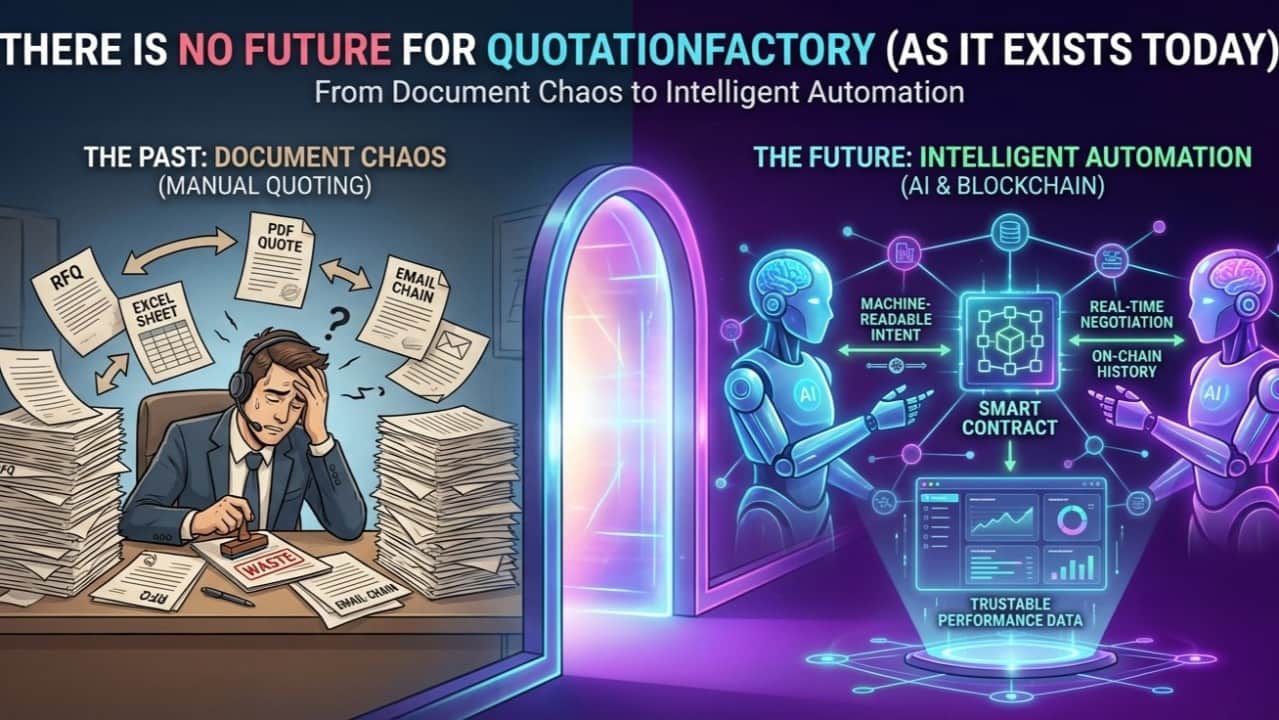
Traditional quotation solutions will disappear as AI agents take over. The future isn't portals where humans input data-it's AI-to-AI negotiation where agents from buyers and suppliers communicate directly, exploring possibilities, negotiating prices, checking capacities, and booking orders automatically. Quoting as a separate activity dissolves into continuous, real-time decision-making within a distributed manufacturing network.
Why quoting, as we know it, will slowly disappear
When you're the CEO of a company, one of your jobs is uncomfortable but essential:
Think through all the scenarios in which your company, as it exists today, no longer deserves to exist.
And the reason is simple (and a bit provocative):
In a lean sense, quoting is waste. The traditional quote document is increasingly… nonsense.
Not the idea of agreeing on price, scope and risk. But the way we do it today: RFQs, emails, spreadsheets, PDFs, manual approvals.
This article is a structured version of a live session where I unpacked one big question:
What happens when AI agents and blockchain take over the functions of a quote?
What a Quote Actually Does (Beyond “It’s a PDF”)
If you strip away the layout, branding and PDF, a quote today fulfills a few core functions:
- It structures information It bundles complex technical and capacity data-materials, tolerances, lead times, pricing models, Incoterms, quality, logistics-into a “single offer”.
- It offers a temporary option Legally it’s an offer. Commercially, it’s a time-bound option: “For X days, I’m willing to deliver Y under these conditions.”
- It creates a basis for comparison It’s the unit of comparison in sourcing: multiple suppliers, multiple quotes, one decision grid.
- It records commitment and responsibility In case of conflict, we fall back on:
- It acts as documentation & audit trail Internal approvals, compliance, cost build-up, savings tracking-everything gets anchored to the quote.
If you summarize this:
A quote is basically a user interface for a structured, time-bound, comparable and traceable offer plus commitment.
The hypothesis I explore is:
If AI agents and blockchain can make all of this transparent and trustworthy… then the document can disappear.
From RFQs & PDFs to Agents & Smart Contracts
1. AI agents replace manual back-and-forth
On both sides of the table, we’ll see specialized agents:
- Buyer agents that:
- Supplier agents that:
Instead of a relay race of RFQ → email → Excel → revision → PDF → more email, we get machine-readable intents and constraints exchanged between agents.
Negotiations become algorithmic, multi-round and scalable, not one-off and manual.
The process ends not with “a signed PDF”, but with a smart contract.
2. Blockchain replaces “trust” with “provable history”
When performance is recorded on-chain, two things change fundamentally:
- Past performance becomes hard data
- Contract execution becomes transparent and partially automatic
Example: If the agreement says “20% penalty if delivery is late,” then the smart contract will automatically apply a 20% discount at payment- triggered by trusted data feeds (called oracles in blockchain).
So a lot of what’s now buried in quote text-“2% penalty for late delivery”- turns into code that runs, not clauses that people argue about.
How Quote Functions Map to a Smart Contract World
Let’s map the original functions of a quote onto this new infrastructure.
- Bundling information → Offer schema Instead of a PDF, you get a standardized data schema:
- Option period → On-chain validity Today: “Valid until 30 November” in text. Tomorrow: the supplier agent publishes an on-chain offer with:
- Comparison → Multi-agent decision making Instead of Excel comparison sheets, buyer agents:
- Commitment → Smart contract + performance ledger
- Documentation → On-chain history + human-readable view
Design Challenges We Still Need to Solve
This is not a magic switch. There are serious questions:
- Legal enforceability
- Soft concepts in hard code Think: force majeure, reasonableness, fairness. Not everything is black-and-white, and we don’t want a world that’s 100% rigid. Some parts will remain legal text; some will be programmable.
- Oracles & data quality Smart contracts need reliable answers to:
- Privacy vs transparency How public can pricing and BOMs be? Solutions will likely involve:
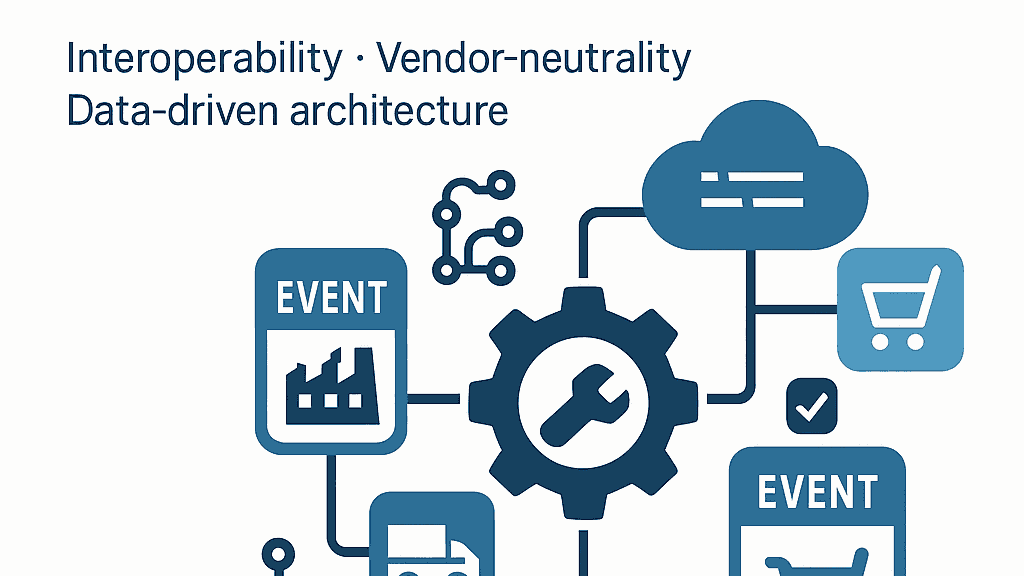
- Standardization & governance Agents must speak the same language:
So What Is a Quote in the Future?
At its core:
A “quote” becomes a temporary negotiation state between agents that eventually hardens into a smart contract, plus a human-readable snapshot.
Concretely:
- Agents negotiate in data formats, not documents
- Within a predefined parameter space
- The result is a smart contract on-chain
- A human-friendly quote/contract view is generated for people
- The document is secondary: a UI for humans, not the truth
What This Means for Quotation Factory
If this scenario plays out, Quotation Factory will need to transform from:
Document generator → Protocol orchestrator
That implies new core functions:
- Agent interfaces APIs for buyer and supplier agents to exchange constraints and intents.
- Negotiation engine Standardized algorithms for bids, counter-bids, multi-round negotiation and multi-supplier optimization.
- Presentation & reputation layer
- New human UI Humans will still need oversight and approval rights. But the interface will look more like control panels for agents and contracts, less like “fill in this quote template”.
The one familiar thing that will remain?
Automatically generating a quote view… but now as a rendered snapshot of a deeper, executable contract.
This Won’t Be a Big Bang
I don’t expect a sudden overnight shift. More likely, we’ll see three phases:
- Digital quotes with AI assistance (no blockchain yet)
- Hybrid contracts
- Full agent-based negotiation with smart contracts as default
A Future Scenario: How a “Quote” Might Work
Imagine this flow:
- The ERP system detects a need: 5,000 pcs of part X.
- The buyer agent, aware of:
- Supplier agents respond with machine-readable offers.
- The buyer agent optimizes and negotiates. Where agreement is found, smart contracts are instantiated and recorded on-chain.
- The system generates a human-readable quote / contract summary for people.
- Execution is monitored automatically via oracles:
We might still call it a “quote”, but the meaning of the word will have completely shifted.
One Step Further: No Quoting at All?
You can even imagine a scenario where:
- A supplier proves on-chain that they consistently meet targets
- The demand side grants them a certain agreed margin / return
- Everything is done via post-calculation invoicing, within boundaries
In that world, you don’t need traditional quoting at all. You need trustable performance data and clear guardrails.
Over to You
This entire exploration started from one uncomfortable CEO question:
“Under what conditions does Quotation Factory, as it is today, no longer make sense?”
I don’t claim this is the only future, or that it will be clean and linear. But I do believe we are moving towards a world where:
- documents become UI
- data becomes the truth
- and agents plus smart contracts do most of the heavy lifting.
I’m curious:
- Do you see this as a realistic scenario for manufacturing supply chains?
- Where do you think this breaks in practice-legal, culture, data quality, something else?
- And what would need to be true for your organization to move in this direction?
Feel free to share your perspective or tag someone in purchasing, sales or operations who should be part of this conversation.