Twin Visions: A Journey of Discovery in Digital Transformation
How state transition models have a critical role in achieving event-driven and agile manufacturing processes.
Once upon a time, in the bustling heart of an industrial city, there stood a metalworking factory. Its chimneys kissed the sky, and its machines roared day and night, shaping metal with fiery breath. The owner of this factory, Mr. Steel, was a visionary with dreams bigger than the giant gears and pistons of his establishment. He envisioned his factory at the forefront of Industry 4.0, a beacon of digital transformation in the manufacturing world.
To turn his dream into reality, Mr. Steel sought the expertise of Ms. Analytica, a renowned business analyst with a sterling reputation in the banking and insurance industries. Her task was to unravel the intricate tapestry of the factory's business processes, creating a detailed process map that would serve as the foundation for the factory's digital metamorphosis.
Ms. Analytica embarked on her mission with zeal. She spent months interviewing workers, studying workflows, and analyzing every cog and wheel of the factory's operations. Her process maps blossomed like intricate blueprints, revealing the flow of information and materials through the labyrinth of factory processes.
Meanwhile, Mr. Steel hired a firm specializing in digital twin technology. Their goal was to create a digital mirror of the factory, modeling machines and manufacturing flows in stunning three-dimensional detail. This team of tech wizards dove into their work, crafting digital twins that were not just functional but visually breathtaking.
A year of tireless effort passed, and Mr. Steel organized a grand business dinner to celebrate the milestones achieved. The air buzzed with excitement as Ms. Analytica and the digital twin team shared their accomplishments. The factory floor, the heart of the manufacturing process, had been meticulously modeled by both parties.
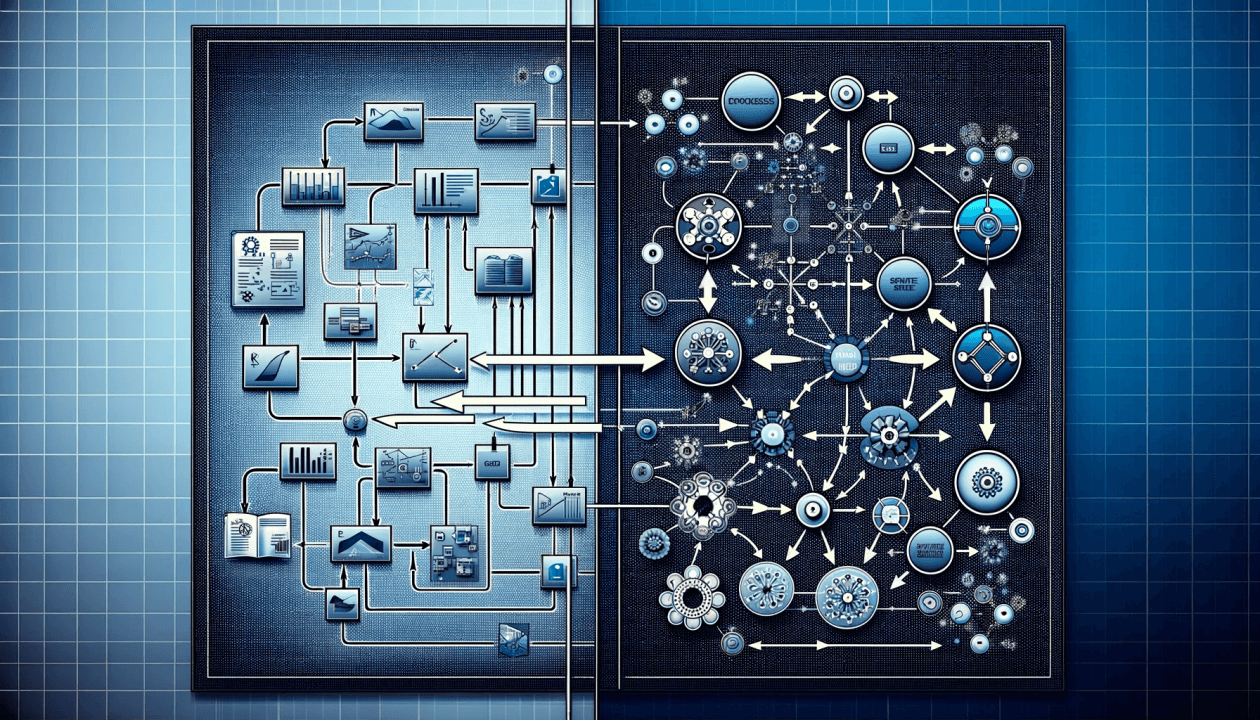
As Mr. Steel listened, a revelation dawned upon him. Despite their different approaches, both the process models and the digital twins captured the same reality. Where Ms. Analytica saw sequences of processes triggered by events, the digital twin team saw statuses and state changes, also triggered by events. Each arrow in Ms. Analytica's process models corresponded to a state change in the digital twins, and vice versa. It was as if they were two sides of the same coin, interconnected and interdependent.
This realization was both enlightening and disheartening. The effort seemed duplicated, yet it was this very duplication that illuminated the fundamental truth: depending on the discipline, the same reality could be modeled in different ways. In the banking and insurance industries where Ms. Analytica hailed from, process models reigned supreme, elegantly mapping the flow of information and decisions. But in the tangible world of manufacturing, where physical states and changes were paramount, the state transition models of the digital twins proved more intuitive.
Embracing this new understanding, Mr. Steel charted a path forward. Ms. Analytica began the complex task of transforming her process models into state transition models, aligning them with the digital twins' architecture. The models were fine-tuned, incorporating time-related constraints and requirements, and categorizing events by business concerns such as manufacturing, sourcing, and maintenance.
As the transformation unfolded, the factory began to change. Machines communicated with each other, predicting maintenance needs and optimizing production flows. The digital twins became more than just models; they were the nerve center of the factory, pulsing with real-time data and insights.
Through this journey, Mr. Steel learned a valuable lesson. Process models and state transition models, though different in form, were fundamentally connected. Each offered a unique lens through which to view and understand the complexities of his business. And in the symphony of digital transformation, both were essential in harmonizing the melody of progress.
As the factory hummed with newfound efficiency and intelligence, Mr. Steel gazed at the digital displays and marveled at the journey that had brought him here. In the fusion of process and state, in the melding of vision and technology, his dream of leading the charge towards Industry 4.0 had become a vivid reality.