When drawing guidelines lock up your supply chain
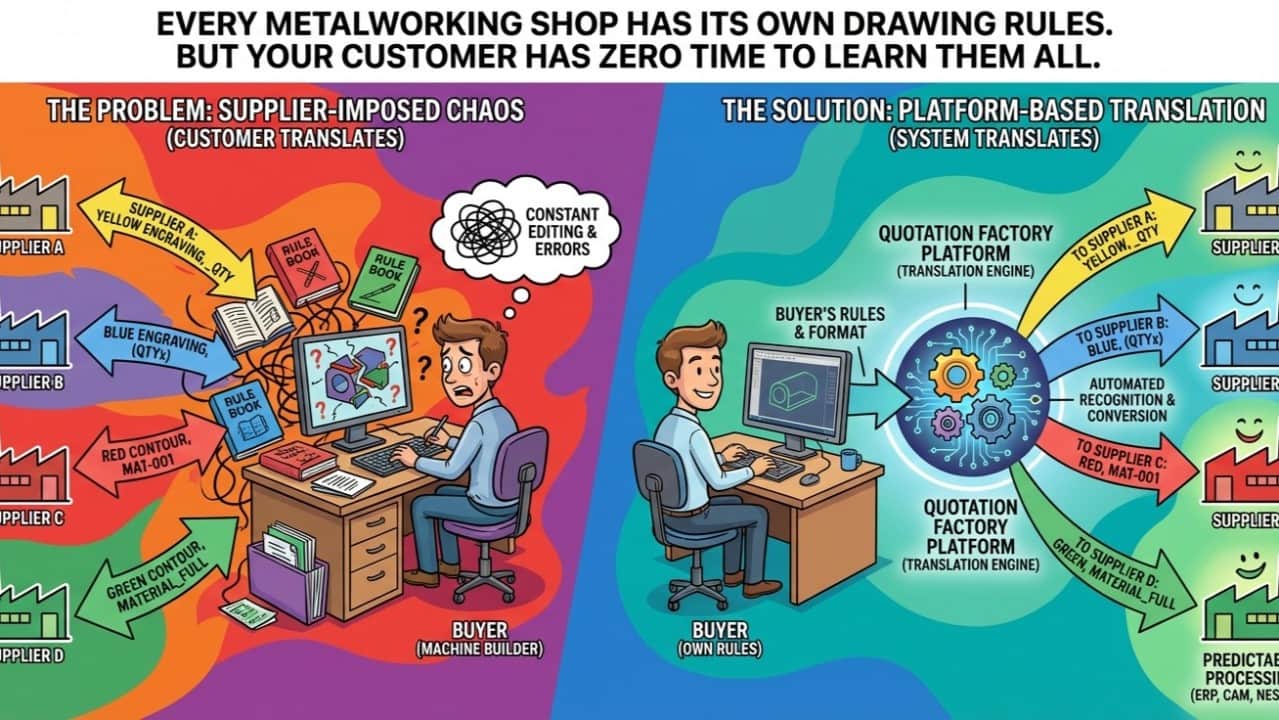
Drawing guidelines lock up your supply chain because every metalworking shop has its own rules (contour colors, file naming conventions, layer structures) but customers have zero time to learn them all. The solution is building intelligence on the supplier side that adapts to varying customer drawing styles, using AI to interpret intent rather than demanding compliance with rigid guidelines-making your business easier to work with and removing friction from the supply chain.
Every metalworking shop has its own drawing rules. But your customer has zero time to learn them all.
A few days ago, our customer success team sent me what looked like a simple bug report.
But when we dug into it, something else became obvious:
This wasn’t just a bug in the software – it exposed a bug in how the supply chain is organized.
And that’s what I want to unpack here.
It looks like a drawing problem, but it’s really a translation problem
Here’s what we see everywhere in metalworking:
Every supplier has its own PDF or webpage with “drawing guidelines”:
- How files must be named
- Which colors to use for which contours
- How to encode quantities in the file name
- What is and isn’t supported in 2D and 3D models
- How to deliver engravings, cut-outs, bends, etc.
From the supplier’s perspective, that’s understandable. You organize your factory so that if input comes in a very specific way, you can process it efficiently.
But from the customer’s perspective - the machine builder, engineer, or buyer sending inquiries to multiple suppliers - it’s completely illogical.
Because this is the reality for that customer:
- Supplier A wants engravings in yellow
- Supplier B wants them in blue
- Supplier C wants the quantity in the file name with an _
- Supplier D wants (2x) with a space in front
- Another wants materials abbreviated one way, someone else another way
So what happens?
The buying party is constantly editing their own input just to satisfy all these different “house styles”.
It’s inefficient, error-prone, and the opposite of user-friendly. Especially if you want to move towards self-service.
How companies work today – and why it doesn’t scale
Let’s be honest about how most of the chain works today:
- Supplier publishes drawing and file guidelines on their website
- Customer tries to adjust their CAD output to fit those rules
- For every new supplier, the customer must:
- In practice, they can’t keep that perfectly consistent, so:
Now add self-service into the mix:
We ask the customer to upload their files into a portal, but we still expect them to follow our very specific drawing rules.
If every supplier speaks a different “drawing language”, self-service becomes one big translation problem - and the customer is doing the translating.
That’s not how you scale.
The conclusion we drew: drawing rules belong with the customer
That bug report forced us to step back and ask a different question:
What if the supplier didn’t enforce drawing and file rules at all… and the customer could simply keep using their own?
In the Quotation Factory platform we use concepts from UBL (Universal Business Language):
- Buying party – the customer / machine builder placing the order
- Selling party – the metalworking supplier fulfilling it
Traditionally, each selling party imposes its own drawing rules.
We flipped that.
Here’s what we did instead:
- Drawing and file guidelines are configurable per buying party
- The customer can keep their own way of:
- Our platform does the translation in the background into what each supplier needs
- The metalworker still receives files that fit their factory and processes
So:
- The customer continues to work the way they’re used to
- The supplier continues to receive input in the structure they need
- The system takes care of translating between the two
That’s the real shift.
Our approach: the system is the translator
This is how we think it should work in a modern, digital chain:
- The customer owns their rules The buying party defines once how their drawings and file names are structured.
- The platform learns that language We configure how to interpret their models, layers, colors, file names, etc.
- The platform translates per supplier For each selling party, we know how to convert that input into the format their factory expects.
- Processing becomes predictable ERP, CAM, nesting, pricing – they all receive consistent, structured input.
- Self-service finally makes sense The customer uploads as usual, without having to think: “Wait, what does this supplier want me to change again?”
Instead of pushing complexity onto the customer, you absorb it into the process design and automation layer.
That’s the core of what we do at Quotation Factory: we don’t just add a tool on top, we redesign the flow between commercial input and technical processing.
Why this works (and keeps working as you grow)
If you design the chain this way, a few good things happen almost automatically:
- Less friction for customers They’re not learning new rules for each supplier. They just work in their own environment, with their own templates.
- Less manual work for suppliers There’s less interpretation, less fixing, less “can you resend this with a different name?”.
- Fewer errors Because the rules are captured in the system instead of in someone’s head, you avoid the typical “I thought this meant X” problems.
- Faster quoting If input is structured and predictable, your ability to auto-quote or at least semi-automate goes way up.
- Real digitalization, not just digitization You’re not just moving PDFs and DXFs from email to a portal. You’re actually structuring, translating, and automating how they flow through your factory.
For many metalworking companies, this is the missing link between:
“We receive drawings by email and process them manually”
and
“We run a digital factory where customers can self-serve and we can still sleep at night.”
Average teams vs. top teams
Here’s the contrast I see in the market:
Average teams:
- Post a PDF with drawing guidelines on their website
- Expect each customer to follow those rules
- Fix exceptions manually via email and phone
- Depend on a few “key people” who know all the quirks
Top teams:
- Accept that every customer has their own way of working
- Build a system that translates customer input automatically
- Standardize and automate internally, not by forcing customers to change
- Use self-service as a way to make life easier - not harder - for their buyers
Quotation Factory is built for those top teams: the metalworking companies that want to digitalize their factory without putting their customers in a straitjacket.
So… who **should** define the drawing rules?
All of this started with a simple bug report. But it led us back to a fundamental question:
Who should define the rules of the drawing - the supplier or the customer?
My view is clear:
- The customer should be free to work in their own way
- The system should do the translation to what the factory needs
That’s the only way to make self-service truly work for both sides.
If you’re a metalworker or machine builder and you’re curious:
- how we configure drawing and file rules per buying and selling party, and
- how that translation works in the Quotation Factory platform,
send me a message.
I’m happy to walk you through it using real examples from your chain.