Why 'First Stability, Then Improvement' **Never** Works in High-Mix Manufacturing
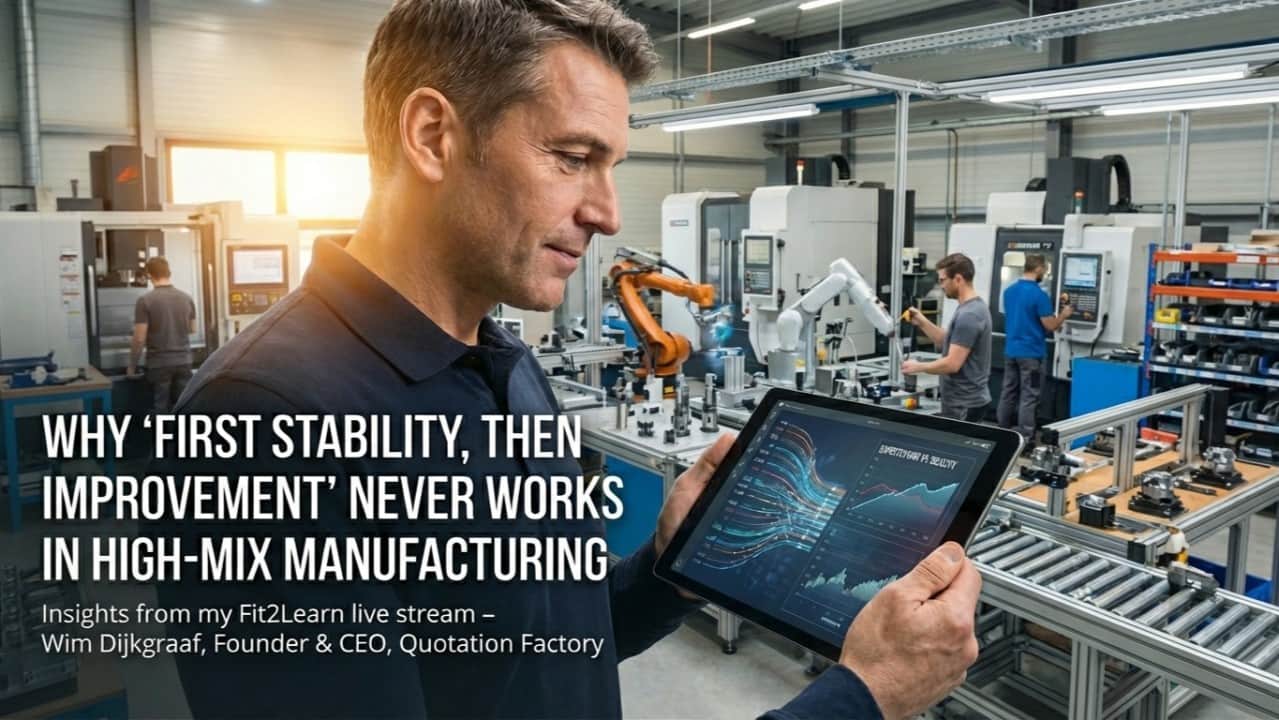
In high-mix manufacturing, waiting for stability before improving is a trap-that calm moment almost never comes. Variability is structural, not temporary, because it comes from multiple sources: customer requirements, engineering changes, material availability, and capacity constraints. The solution is to build improvement capacity into normal operations, train while producing, and create systems that learn from variability rather than waiting for it to disappear.
Insights from my Fit2Learn live stream
Wim Dijkgraaf – Founder & CEO, Quotation Factory
If you run a high-mix manufacturing business, chances are you've said (or thought) this before:
- "We just need to get through this busy period."
- "Once it calms down, we'll fix this properly."
- "After this peak, we'll improve structurally."
The myth of “temporary pressure”
Many improvement initiatives in manufacturing are based on one deeply rooted assumption:
The variability we’re experiencing now is temporary. Sometimes that’s true. But structurally, it’s not true in high-mix environments.
Why?
Because variability doesn’t come from one place. It comes from many sources at once:
- Customer-specific requirements
- Engineering changes
- Strongly fluctuating order sizes
- Unpredictable lead times
- Limited or shifting availability of people and expertise
- Machine breakdowns
- Shorter delivery expectations
And here’s the key point: Those sources of variability don’t disappear at the same time.
When one eases, another intensifies.
So every month feels like an exceptional month. And that “temporary” situation quietly shifts forward… month after month… year after year.
What waiting for stability really does
When you wait for stability before improving, something subtle but damaging happens:
- Improvements are planned, but postponed
- Initiatives are paused “just for now”
- Decisions are pushed forward
- Problems are solved through experience and improvisation
That works - until it doesn’t.
Shortcuts slowly become normal:
- “Jan will handle that special case.”
- “We’ll fix the planning later.”
- “Engineering will decide downstream.”
And that creates a painful paradox:
The busier it gets, the less you improve. And the less you improve, the busier it stays.
High-mix doesn’t stabilize. The complexity simply accumulates.
The real system behind your factory
Here’s where it gets interesting.
In every exception, something happens that often goes unnoticed:
- A decision is made
- An assumption remains unspoken
- A trade-off is not documented
These decisions feel efficient in the moment - and then they disappear.
But they don’t really disappear.
They come back later as:
- Misunderstandings
- Conflicting assumptions
- Re-decisions
- Firefighting
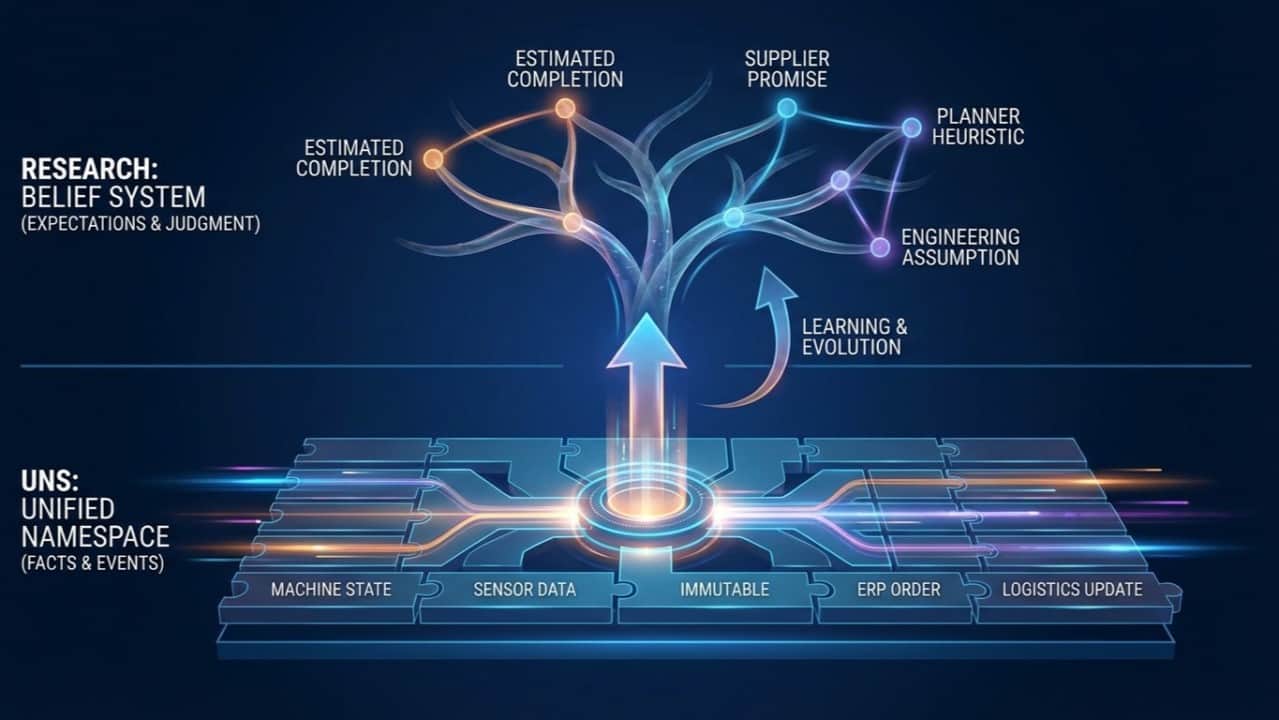
Your organization runs on expectations:
- Expected lead times
- Expected capacity
- Expected sequence
- Expected quality
- Expected availability of people, machines, materials, cash
Most of these expectations live only:
- In people’s heads
- In spreadsheets
- In ad-hoc conversations
They are rarely made explicit, testable, or learnable.
And that’s a problem.
Expectations vs. reality: where learning really happens
In high-mix manufacturing, work constantly unfolds as a clash between:
- Expectations → future events
- Events → what actually happens
Orders arrive unexpectedly. Engineering changes ripple downstream. Plans shift. Deliveries move.
No one is necessarily doing anything wrong.
But without explicitly capturing expectations and matching them to real events, the organization doesn’t learn.
The same decisions keep returning. The same surprises keep happening. The same pressure keeps building.
So... what should improvement look like in high-mix?
This is not a plea for:
- Working harder
- Adding more systems
- Automating faster without thinking
High-mix improvement must do something else:
It must work during variability - not after it.
That means:
- Not trying to eliminate variability (you can’t)
- Learning to make expectations explicit
- Continuously testing expectations against reality
- Adjusting decisions while work is in progress
The constant in high-mix isn’t stability.
The constant is the type of decisions you keep having to make.
That’s where improvement starts.
A question for you
So let me end with the same reflection I shared in the live stream: Where in your organization are you still waiting for “calm” before something is allowed to work better?
And what is the real chance that calm will actually arrive?
- If stability never comes, then the real question becomes:
What is the true production system in high-mix manufacturing?
My answer: Not your machines - but the decisions you make, and the expectations hidden inside them.
More on that in the next Fit2Learn session.