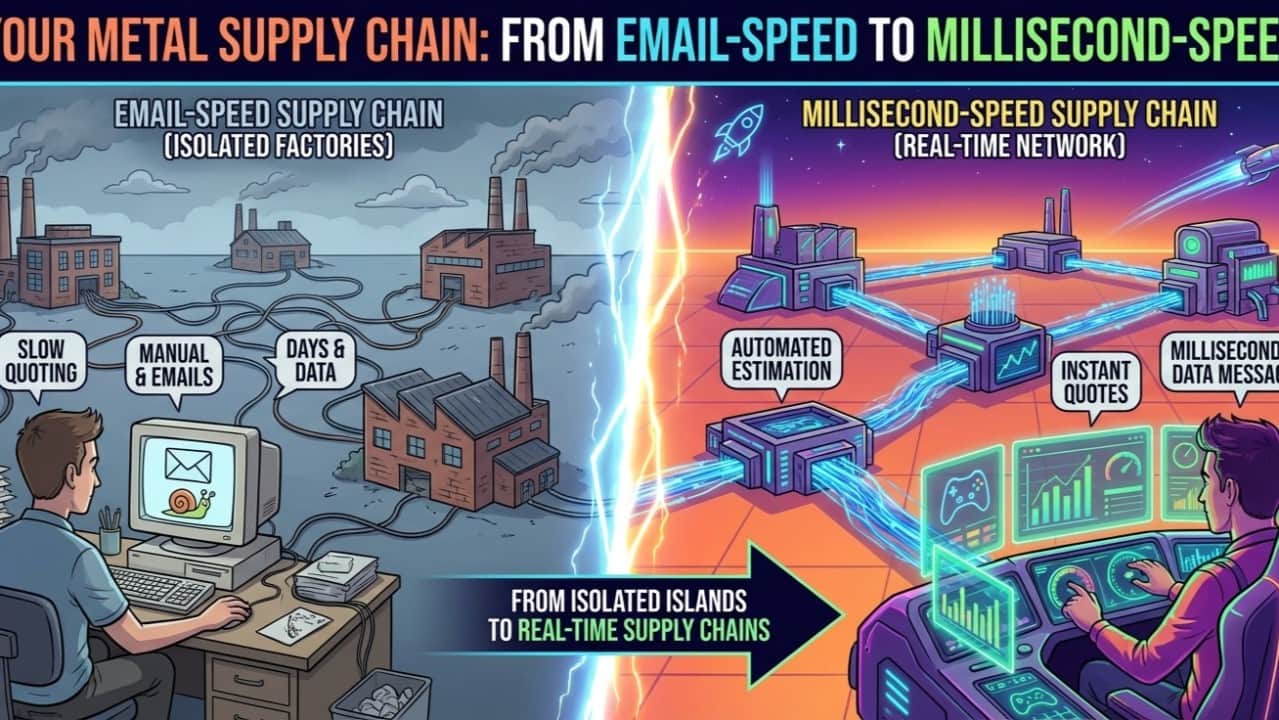
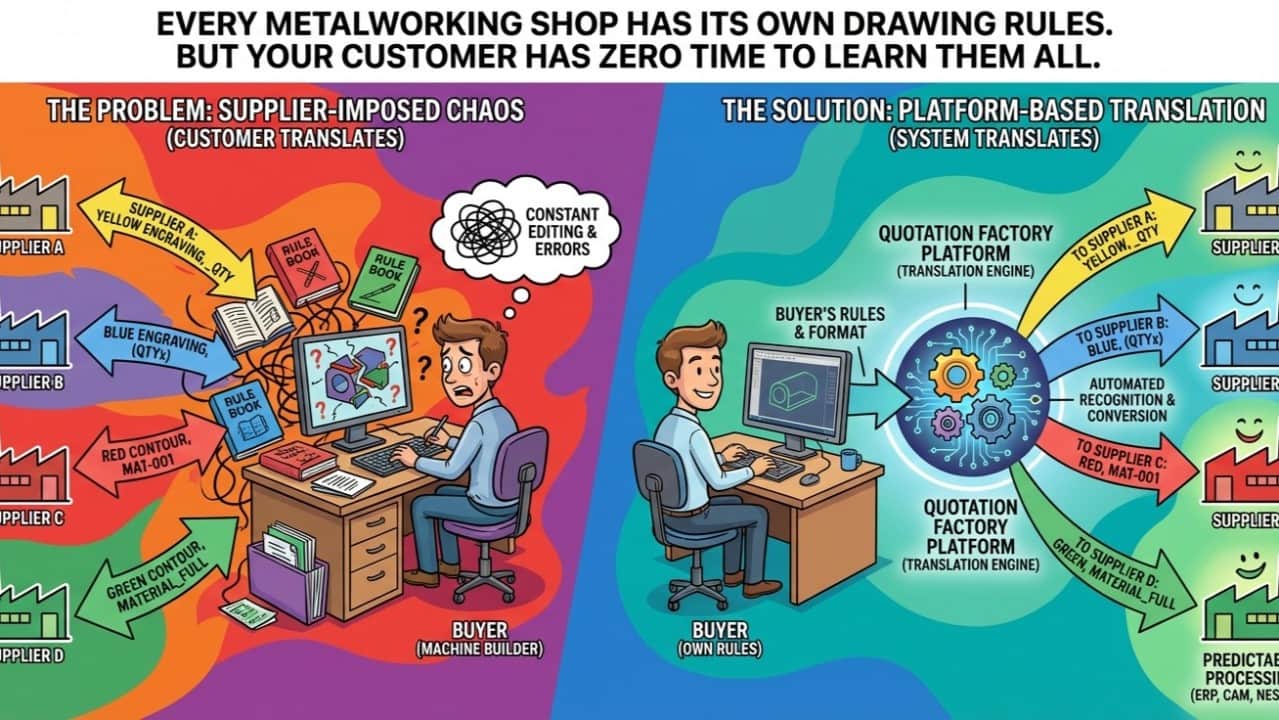
Your factory isn’t “just” a factory anymore. It’s a multiplayer world.
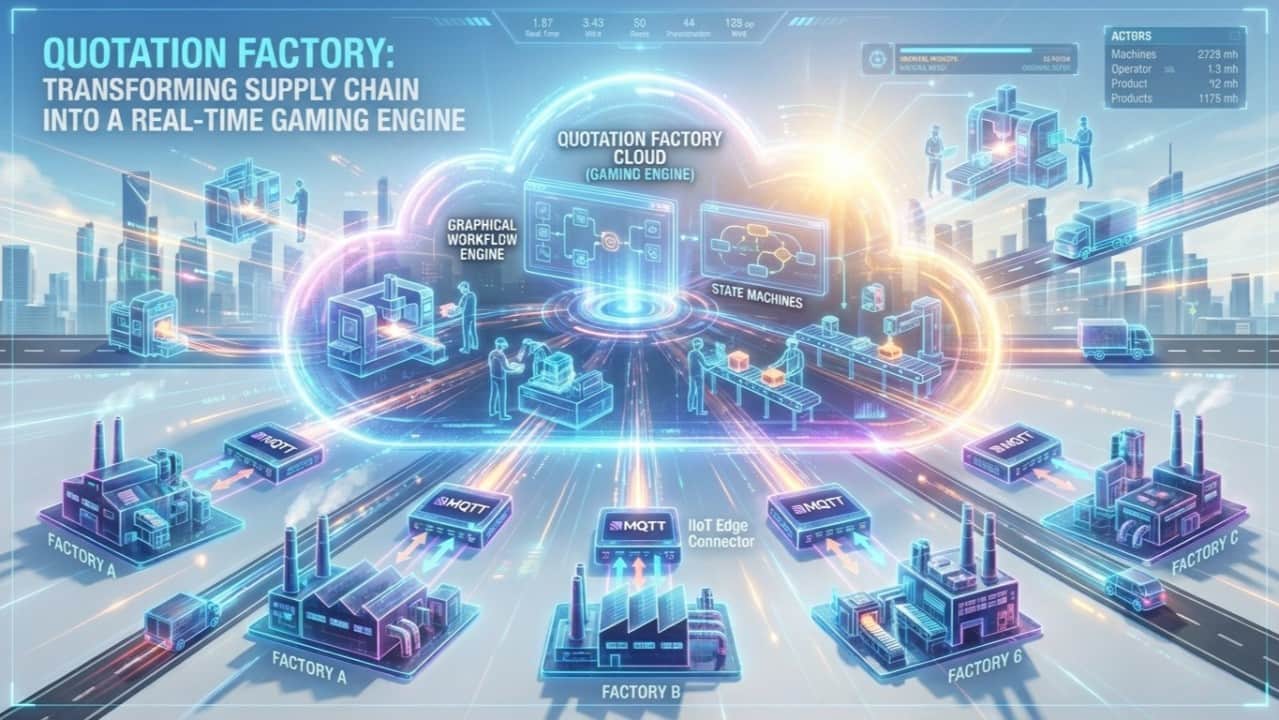
In my previous live session, I shared how we’re building a supply chain integration platform for metalworking that behaves more like a gaming engine than a traditional IT system – with factories interacting in (tens of) milliseconds.
In the second session – the one this article is based on – I added the missing piece:
Quotation Factory is not only a cloud platform. It’s also a communication platform that reaches all the way into your machines, systems and shop floor.
That’s where the real transformation starts.
The real problem: cloud-only thinking
A lot of digital initiatives in manufacturing look like this:
- “We’ll move more to the cloud.”
- “We’ll buy a new MES.”
- “We’ll integrate ERP and CAD/CAM.”
All good intentions. But if you look closely, most of these projects share a hidden limitation:
They treat the factory as a black box.
Data may be pushed to a dashboard, but the actual conversation between:
- machines
- MES
- ERP
- CAM
- and the people running the shop
…is still slow, fragile, and full of one-off integrations.
You end up with a “modern” architecture that still behaves like yesterday’s IT:
- point-to-point connections
- custom scripts
- file drops and manual imports
- latency between what really happened and what the system thinks happened
So even if your quoting or planning runs in the cloud, your feedback loop to reality is broken.
How we look at a factory: as an IoT device
In Quotation Factory, we made a very conscious architectural choice:
Every metalworking company we connect is treated as an industrial IoT device.
That sounds strange at first – a factory as a “device” – but it’s powerful:
- Each factory connects to our cloud through Industrial IoT technology
- That connection is secure, reliable, and designed for high throughput (large volumes of messages)
- Behind that IoT connection sits what we call the Quotation Factory Edge Connector
This Edge Connector is where the real conversation with your factory starts.
The Edge Connector: local brain, global orchestration
The Edge Connector is more than a “connector”.
It contains three key building blocks:
- MQTT server and client built in MQTT is a lightweight, publish/subscribe protocol used heavily in industrial IoT. In plain language: it’s a fast, efficient way to let devices and systems talk to each other using events.
- Graphical Workflow Engine Inside the Edge Connector, we’ve embedded a graphical workflow engine that:
- Integration building blocks We’re actively converting common integrations used in the Netherlands into reusable blocks inside this workflow engine, for example:
From the cloud, we can then orchestrate workflows that:
- run locally in the factory
- interact with your systems and machines
- and send the right data back to the Quotation Factory platform in real time
In a later phase, we’ll add AI agents both in the cloud and locally, to:
- interpret signals
- suggest actions
- or even autonomously trigger certain workflows under clear rules
From estimates to reality: closing the loop
Once you have this kind of edge infrastructure, a lot of interesting things become possible.
One simple, practical example:
We can send estimated times from Quotation Factory to your environment and then capture:
- A – What Quotation Factory estimated
- B – What your CAM system simulated
- C – What actually happened on the shop floor (measured machine times)
With the Edge Connector, this isn’t a manual reporting exercise. It becomes:
- a continuous feedback loop
- driven by events from machines and systems
- feeding back into your models, estimates and planning
Over time:
- estimates get sharper
- planning becomes more realistic
- and you get a much clearer picture of where variation and waste really occur
All of that is happening in near real time.
State machines: making assets “behave”
To turn a supply chain into something that behaves like a gaming engine, you need more than just messages. You need behaviour.
That’s why our architecture also incorporates state machines.
In simple terms:
- A state machine describes the possible “states” of an asset and how it moves between them.
- For example, a job might go from:
- Each transition can trigger events and workflow steps.
We can model these state machines for various assets in your factory:
- jobs
- machines
- tools
- transport carriers
- work orders
- batches
Then, those state transitions:
- generate events
- update the actors in our Orleans-based actor model in the cloud
- keep the entire digital representation of your supply chain in sync with what’s really happening
That’s why, in the architecture drawing I showed in the live session, you see:
- state machines
- graphical workflow engine (local and in the cloud)
- MQTT / Edge Connector
- actor model in the cloud
All working together as one system.
Unified Namespace: giving your factory a single language
The Edge Connector also contains all the infrastructure needed to build a Unified Namespace (UNS).
A UNS is basically:
One structured, consistent “place” where all production-relevant data is published and organized.
Instead of each system talking directly to each other in different formats and languages, you get:
- a shared “dictionary” of topics and structures
- all events and states flowing through that namespace
- integrations that subscribe to what they need instead of wiring everything point-to-point
We will provide:
- guidelines on how to structure that namespace
- templates to set it up according to best practices right from the start
This becomes the backbone for digital transformation in a metalworking factory – and, when many factories are connected, for the entire supply chain.
Why I keep calling it a “gaming engine”
Under the hood, Quotation Factory runs on Microsoft Orleans, an implementation of the actor model originally developed to power the game Halo.
In that world, Orleans had to:
- manage huge numbers of live “actors” (players, objects, events)
- keep their state synchronized
- and ensure they could interact in real time across distributed servers
We’re using the same principles for metalworking:
- each factory, system, job, asset, or role is represented as an actor
- state machines and workflows drive how they behave
- events from the Edge Connector keep everything in sync
- and the entire chain can react in (tens of) milliseconds
That’s why I say:
This isn’t just an information system. It’s a real-time gaming engine for the metalworking supply chain.
Average integrations vs. top-tier architectures
This approach is not for everyone.
- Average setups: _ Top-tier teams and suppliers:
Quotation Factory is designed for that second category: companies and chains that want to operate as a system, not as a collection of isolated factories.
So what does this mean for you?
If you’re a:
- metalworking company
- surface treatment provider
- machine builder
- or OEM
…and you’re wrestling with questions like:
- “How do I really connect my machines, MES, ERP and cloud initiatives?”
- “How do I move beyond dashboards to actual closed-loop control and learning?”
- “How can I prepare my architecture for AI without rebuilding everything later?”
…then this gaming-engine view of your supply chain is very relevant.
If you’d like to:
- see the Edge Connector and graphical workflow engine in action,
- understand how a Unified Namespace could look in your factory, or
- explore how to bring machine reality, simulation and estimation into one feedback loop,
feel free to reach out or send me a message with “gaming engine”.
Because the metalworking supply chain is already complex enough. The architecture that runs it shouldn’t add to that complexity – it should turn it into something you can actually orchestrate.